
PDF-documented product
High Pressure Self-Sealing Power Plant Gate Valve
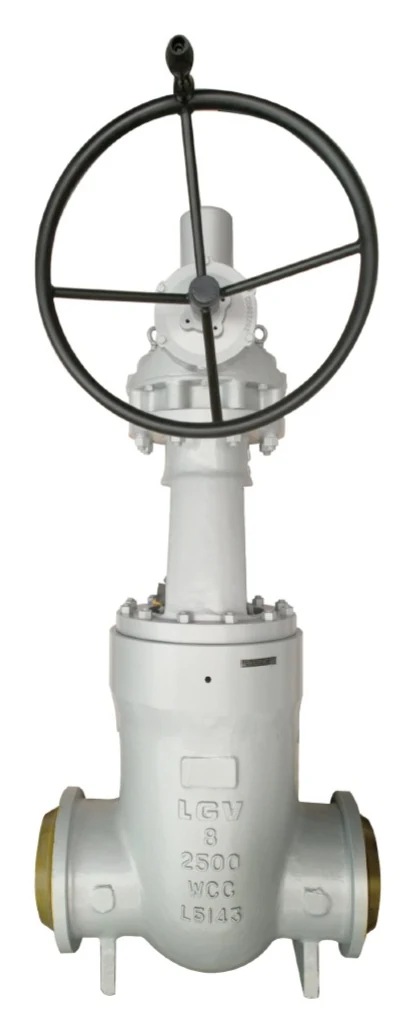
The High Pressure Self-Sealing Power Plant Gate Valve is listed in the source catalog’s Power Station Valve series. Its pressure-seal description concerns the body–bonnet joint, not the seat shutoff class. For a power-plant isolation inquiry, check the required pressure–temperature envelope and maximum differential pressure during opening before choosing the operator. Verified catalog views appear on physical pages 61–62.
- Gate-valve family: normally evaluated for open/closed isolation
- Bonnet: pressure self-sealing catalog descriptor
- Pressure / temperature rating: not established by the catalog images
- Actuation and seat leakage: confirm for the offered configuration
Product identity
What “pressure self-sealing” means on this gate valve
A pressure-seal bonnet uses internal pressure to help compress the body–bonnet sealing interface. The initial sealing arrangement, gasket material and retainer design still have to be established for the actual configuration. Bonnet tightness is not the same as shutoff across the gate and seats, and neither one establishes the pressure class.
Body–bonnet joint
The pressure-assisted closure is the defining construction concept. Request the approved cross-section and bonnet-seal details rather than treating a catalog photo as a sectional drawing.
Valve function
Gate valves are primarily considered for full-open or full-closed service. If continuous flow regulation is required, specify a suitable control-valve duty instead of assuming this gate valve can throttle.
Verified catalog record
Original source catalog, physical pages 61–62 (printed pages 111–114). The primary view on p. 61 and alternate view on p. 62 carry this exact product caption; adjacent electric and ASME-labeled designs are separate catalog identities.
Configuration evidence
What is documented—and what must be specified
The catalog label establishes the gate-valve family, pressure self-sealing descriptor and power-station context. It does not identify an orderable size range, pressure class, material grade, operating differential, seat-leakage limit or code compliance for WP174. Use the proposed configuration datasheet for those decisions.
| Selection field | Known information or required document | Evidence status |
|---|---|---|
| Product identity | Gate valve; power-plant catalog series | CONFIRMED — source headings, pp. 61–62 |
| Bonnet construction | Pressure self-sealing (catalog descriptor) | CONFIRMED AS NAME — internals require drawing |
| Pressure class / rating | Not specified for this catalog identity | REQUIRES OFFERED PRESSURE–TEMPERATURE DATA |
| Size and end connections | Not specified; do not dimension from photos | REQUIRES GA DRAWING AND END DETAIL |
| Disc, wedge, seat and leakage | Not specified by verified image captions | REQUIRES TRIM DETAIL AND SEAT-TEST CRITERIA |
| Actuation / opening differential | Configuration not established by catalog caption | REQUIRES OPERATOR AND ΔP REVIEW |
| Materials and gasket | Exact body, trim and bonnet seal materials not identified | REQUIRES MATERIAL SCHEDULE |
| Product-specific design / test standards | No compliance claim supported by these labels | REQUIRES APPLICABLE CODE AND TEST PLAN |
| Mapped catalog photographs | Primary image: physical p. 61; alternative view: p. 62 | CONFIRMED — caption-to-image comparison |
Selection rule: first check the permitted pressure at the actual design temperature, then check seat shutoff and opening force as separate requirements. A nominal Class or PN designation alone is not a maximum allowable pressure at every temperature.
Engineering distinction
Keep bonnet sealing, shutoff and operating load separate
Three different conditions can cause an unsuitable selection even when the product name sounds appropriate: a bonnet-seal concept does not set seat leakage; the word “high pressure” does not set the pressure–temperature rating; and line pressure does not tell you how much differential pressure the operator must overcome at opening.
Do not infer these from the name or photos
- Bonnet joint: pressure-assisted sealing is a closure principle, not a zero-leak claim.
- Seat shutoff: wedge/disc type, seat materials and leakage acceptance need their own specification.
- Pressure class: check the offered material and rating basis at design temperature.
- Operator: the handwheels shown in catalog illustrations do not establish the supplied drive.
- Standards: the adjacent ASME-captioned entry is a different product and proves no WP174 compliance.
Ask for these project-specific proofs
- Offered GA drawing, sectional drawing and connection details
- Pressure–temperature rating, body/bonnet materials and gasket design
- Seat arrangement and stated shutoff/leakage test acceptance
- Maximum ΔP during opening and required operator torque/thrust
- Applicable design, inspection and pressure-test standards
- Inspection records, certificates and IOM documentation as specified
Procurement engineering
How to decide whether this pressure-seal gate valve fits
Use this catalog identity as a starting point for high-pressure isolation, not an approved configuration. The following checks separate a feasible offer from a visually similar valve that cannot meet the line duty.
Isolation versus throttling
If the duty is isolation with defined open and closed states, a gate valve can be evaluated. If the process must regulate flow while partly open, specify a purpose-designed control valve: sustained partial opening can damage gate and seat surfaces. Define the required shutoff test separately from the bonnet joint.
Pressure rating at temperature
State design pressure, normal and upset pressures, design/minimum temperature and service medium. Ask for the offered valve’s material-dependent pressure–temperature rating; do not interpret “high pressure” as a particular Class, PN or allowable pressure across the full temperature range.
Opening against differential pressure
The highest differential pressure when the valve must open may be different from its steady operating pressure. Provide upstream/downstream pressures for startup and emergency states. The supplier must check unseating thrust, operating torque and whether an engineered pressure-equalization arrangement is necessary; no bypass is established for this catalog entry.
Bonnet seal, seats and materials
Request body and trim grades, gate/seat construction, stem packing, pressure-seal gasket and sealing faces. Thermal cycling, fluid chemistry and erosion conditions can change the appropriate materials and leakage requirement. Neither the visible wheel nor cast markings prove a complete materials schedule.
Drawing, test and operator evidence
Use the approved general arrangement, pressure–temperature basis, seat-test acceptance, body test, bonnet detail and torque/thrust calculation to compare offers. Specify gear/manual/electric actuation as a requested configuration, with electrical or control details only when relevant. Documents and inspection scope must be included in the actual quotation.
Power-plant service review
Where operating conditions can change the selection
The catalog places the valve in its power-station series. Whether a specific steam, condensate or other power-plant line is suitable depends on the proposed configuration and service history—not the catalog heading alone.
Startup and thermal cycling
Repeated heat-up and cool-down cycles can affect gasket loading, stem/seat clearances and operation. Give the startup sequence, expected thermal transients and cycling frequency so the bonnet, trim and operator can be reviewed together.
Trapped pressure and difficult opening
For lines that can trap fluid in the valve cavity or experience substantial closing/opening differential, ask engineering to assess pressure locking and thermal binding for the actual disc and body geometry. These are evaluation hazards, not verified faults or features of WP174.
End connections and installation
Check weld-end or flange requirements, pipeline bore, available stem clearance, orientation, pipe loads and maintenance access against the approved drawing. Photos cannot establish end preparation, dimensions or installation limits.
Verified photography
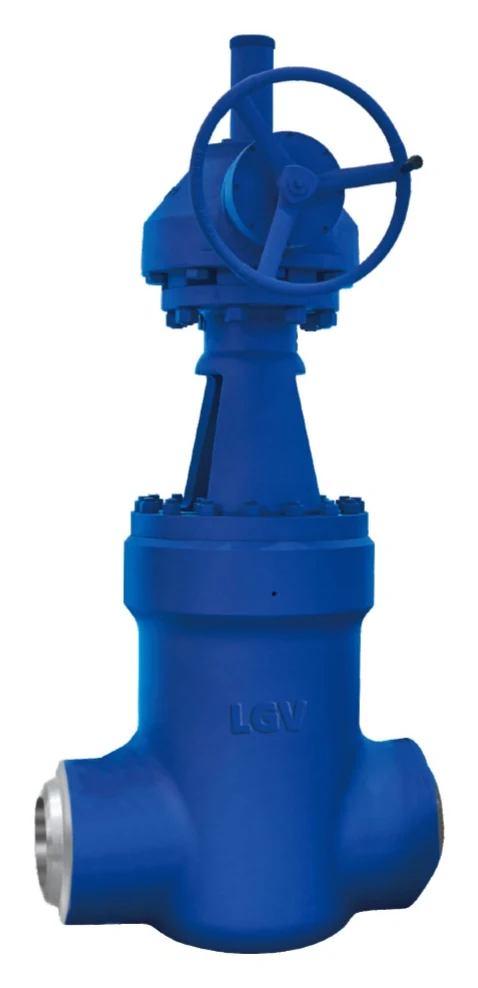
An alternate catalog view of this product
The main image is from physical catalog page 61. The different view below is from page 62 and carries the same product caption. Both illustrate catalog appearance only—not the final supplied operator, dimensions, pressure class or seat arrangement.
Related catalog choices
Compare a manual, electric or forged alternative
Do not transfer ratings or actuator choices from the following pages. Use each linked catalog identity to decide which construction to request for technical review.
Electric Forged Steel Power Plant Gate Valve
An electric, forged-steel catalog identity. Compare only when the project explicitly requires that construction and an electric operator; its specifications need separate confirmation.
Manually Controlled Self-Sealing Forged Gate Valve
The linked title specifies a manually controlled, forged pressure-seal design. Review it as a distinct material and operating-route option, not an interchangeable part number.
Electric High Pressure Self-Sealing Power Plant Gate Valve
This electric, high-pressure, self-sealing product is separately labeled in the catalog. Choose its page for an electric-drive request rather than assuming WP174 includes an actuator.
Buyer questions
Pressure-seal gate valve buying questions
Clarifications that matter when comparing a catalog name with an order-ready specification.
Does pressure self-sealing guarantee zero seat leakage?
No. Pressure sealing describes the body–bonnet joint. Shutoff across the gate and seats is a different sealing interface, with leakage limits determined by the offered seat design and specified acceptance test.
What pressure class and temperature limit does this entry cover?
The verified catalog captions do not establish numeric pressure or temperature limits. Request the offered size, material, pressure–temperature rating basis and design conditions before accepting a Class or PN designation.
Is an electric operator included on the illustrated valve?
No supplied operator is established by this catalog identity. A separately captioned electric high-pressure self-sealing gate valve exists; specify required actuation, maximum opening differential pressure and control or utility needs for a quote.
Which data makes an RFQ technically actionable?
Send the medium, size and end connections, design pressure and temperature, upstream/downstream pressures during opening, isolation and seat-leakage requirements, actuation preference, quantity and required drawings, tests and certificates.
Technical RFQ
Request an offer for this pressure-seal gate valve
Reference High Pressure Self-Sealing Power Plant Gate Valve and send the main line conditions. VALMORA can review a proposed size, operator, seat arrangement, bonnet detail and documentation scope against the stated duty; any supplied configuration must be confirmed in the quote and approved drawings.
- Service medium and isolation duty; required seat-leakage acceptance
- DN/NPS, end connection, design pressure and temperature
- Maximum differential pressure during opening and transient conditions
- Requested body/trim/gasket materials and actuation method
- Quantity, GA drawing, tests, certificates and witness requirements