
Process isolation · industrial valves
Industrial Diaphragm Valves
A diaphragm valve uses a flexible membrane to close against the valve body while separating the process medium from the operating mechanism. For chemical and process lines, selection depends on the flow passage, body lining, diaphragm compound and complete pressure-temperature duty—not the valve name alone.
Catalog reference: handwheel-operated, flanged PTFE-lined diaphragm valve. Final materials, ratings, dimensions and availability depend on the requested configuration.
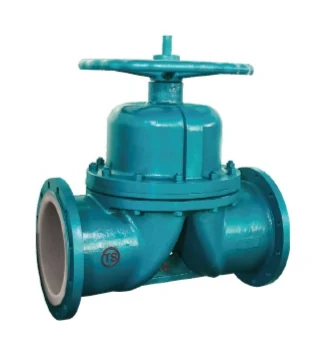
A lined diaphragm valve as a starting point
The valve pictured above is identified as a PTFE-lined diaphragm valve in the supplier catalog. It is a useful example of a manual, flanged process valve—not a complete size range or a verified material specification. For a project quote, request the drawing and the exact diaphragm, lining, pressure-temperature and connection details for the proposed assembly.
Flow path · wetted materials · operation
Choose the diaphragm valve around the service
Start with what passes through the valve and how often it must operate. The internal passage affects flow and solids handling; the body or lining and diaphragm form the primary process-contact boundary. Neither can be selected independently of temperature, pressure and cleaning exposure.
Weir or straight-through passage?
A weir design closes over a raised seat and is often considered where compact diaphragm travel and repeated shutoff matter. If viscous fluid, solids or flow obstruction dominate, ask whether a straight-through passage is appropriate. Compare actual pressure loss, allowable differential and diaphragm design; the external photo does not establish the internal geometry or availability of both styles.
Select the lining and diaphragm together
A PTFE-lined body does not mean the flexible diaphragm is PTFE, nor does a liner name establish chemical compatibility. Specify every process chemical, concentration, operating temperature and cleaning agent. Check the proposed body/liner and diaphragm compound as one wetted-material system, including expected wear and permeation limits.
Manual shutoff or automated operation?
A handwheel is a practical starting point for accessible, intermittent isolation. Remote operation, frequent cycling or fail-position requirements may change the actuator choice and sizing. Some diaphragm-valve designs can throttle, but the differential pressure, flow characteristic and diaphragm duty must support it. For globe-style regulating duty, see Control Valves. A diaphragm-actuated globe control valve is a different construction: its pneumatic diaphragm supplies motion rather than sealing the process passage.
Technical selection
Details that determine the quoted valve
The service case should decide the configuration. Use these inputs to screen a proposal before comparing price or treating a product photograph as a specification.
| Decision | Information to provide | What it changes |
|---|---|---|
| Duty and flow path | Isolation or throttling; medium phase, solids/viscosity, flow and allowed pressure loss | Distinguishes weir from straight-through proposals and sets flow/diaphragm duties |
| Chemical exposure | Fluid mixture, concentration, temperature, additives and cleaning chemicals | Screens the body or lining and diaphragm material together |
| Pressure and temperature | Design and operating pressures; maximum differential, vacuum if present; min/normal/max temperature | Body, liner, diaphragm and actuator limits must all cover the same service envelope |
| Piping and installation | Nominal size, flange or other end standard, face-to-face, pipe orientation and drainability | Determines dimensional fit and whether installation/cleaning is practical |
| Operation and maintenance | Manual or automated duty, cycle frequency, fail position and access for diaphragm replacement | Changes operator package, service plan and documentation needed |
| Required records | Dimensional drawing, material list, pressure-temperature data, tests and project approvals | Defines what must be supplied for the exact quoted configuration |
Application conditions
Where a diaphragm valve can make sense
The same isolation principle can serve different process duties, but the flow passage, wetted materials, maintenance access and required records must change with the medium.
Chemical and corrosive media
A lined diaphragm design may reduce exposure of the metallic body and operating parts to the process fluid. Specify the real chemical mixture, concentration, temperature, cleaning chemistry and upset conditions; material selection must address the diaphragm as well as the liner.
Water treatment and solids-bearing lines
For treatment water, additives, suspended solids and cycling frequency can be as important as nominal line size. Where grit, sludge or viscosity can obstruct a raised weir, review straight-through flow options and the maintenance implications rather than assuming every diaphragm body is interchangeable.
Clean or contamination-sensitive processes
Separating the bonnet mechanism from the fluid can be useful where contamination control matters. That alone does not prove sterile service. If cleaning or sterilization is required, specify the actual procedures, drainability, wetted finish, diaphragm compound and any project-specific compliance documents.
More product and project context
Continue from the right technical source
If the process duty points to another valve family, return to the product overview. Project applications and supplier information can support an inquiry, but the proposed diaphragm valve still needs a configuration-specific datasheet.
Compare other valve families
For abrasive solids or slurry, compare the pinch-valve sleeve closure with a diaphragm closing against a body seat. Browse other valve families if shutoff or regulating duty points elsewhere.
View industry applications
Place the valve choice in the broader process, fluid handling and operating environment.
Read manufacturing information
Review the company information, then request records specific to the quoted valve if your project requires them.
Consult technical resources
Use engineering guides for background, without substituting them for the proposed valve data.
Technical inquiry
Request a diaphragm valve configuration review
Send your process duty and available piping information. VALMORA can review the requested configuration and identify the drawing, materials, limits and supporting documents that need to accompany a quote; uncertain items can be listed as questions rather than guessed.
- Service medium: full chemical composition, concentration, solids and cleaning fluids
- Line size, end-connection standard, mating flange and face-to-face constraints
- Operating, design and upset pressure; differential pressure and any vacuum duty
- Minimum, normal and maximum operating and cleaning temperatures
- Preferred body/lining and diaphragm materials, or compatibility questions
- Isolation or throttling duty, cycling frequency and manual/automated operation
- Required fail action, available air/power and control signal if actuated
- Drawings, test reports, material records and applicable project specifications