
Knife gate valve | Lug-style connection
Lug Knife Gate Valve
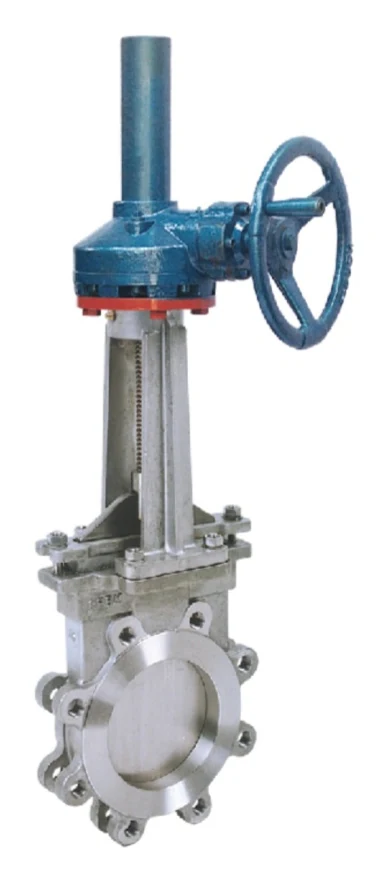
A lug knife gate valve is considered where the piping design calls for a lug-style body connection rather than relying solely on a wafer-style clamped joint. The supplier catalog identifies this product by name, but does not publish a size range, flange drilling, differential-pressure rating or seat design for this specific listing.
Start with the mating flanges and isolation duty: confirm the bolt engagement and installation drawing, then check flow direction, shutoff differential pressure, medium and sealing requirements before a configuration is selected.
- Catalog identity: Lug Knife Gate Valve
- Connection: lug-style; final bolting pattern requires drawing
- Seat, material and duty ratings: configuration-specific
Connection decision
What does the lug connection change?
The value of a lug-style body is in how it interfaces with the pipeline flanges. A lugged arrangement may allow each side to be fastened separately, but the actual body hole pattern, thread engagement and permissible installation remain specific to the offered design.
Between two flanges
Check the valve’s end-to-end dimension, flange face, bolt circle, hole count and thread pattern against both companion flanges. A nominal DN/NPS or PN/Class label alone does not establish a matching installation.
At a line end
Do not assume dead-end capability from “lug.” If the downstream flange or pipe may be removed while the upstream side remains pressurized, request explicit approval for that duty and the rated differential pressure, pressure direction and required supporting hardware.
Bolts and sealing faces
Use the approved hole-depth, bolt-length and gasket/seat arrangement. Bolts that bottom in blind tapped holes can damage the valve or interfere with gate movement; another manufacturer’s torque or bolting table is not a substitute for this valve’s drawing.
Source catalog and order data
What is documented for this listing?
The original supplier catalog, physical PDF page 108 (printed page 206), labels the seventh image as Lug Knife Gate Valve within the Knife Gate Valve series. The image depicts a handwheel-equipped example; it does not establish the standard actuator, pressure rating, body material or order code.
| Item | Known value | What to verify |
|---|---|---|
| Product identification | Lug Knife Gate Valve | Catalog label, p. 108 |
| Connection family | Lug-style knife gate valve | Catalog label; drilling drawing not included |
| Illustrated operation | Handwheel shown in the catalog image | Illustration only; not an orderable actuator specification |
| Size, PN/Class and shutoff ΔP | Not stated for this listing | Request rated size / pressure / differential-pressure data |
| Body, gate/trim, seat and packing | Not stated for this listing | Specify corrosion, abrasion and leakage requirements |
| Face-to-face, flange drilling, bolting | Not stated for this listing | Obtain approved dimensional and flange-bolting drawings |
| Flow direction, dead-end duty and tests | Not stated for this listing | Require written confirmation against the actual operating case |
Use this catalog entry to identify the requested construction. Purchase dimensions and operating limits must come from the exact offered datasheet and drawing, not from the illustration or a related knife gate model.
Service suitability
Select the seat and wetted materials for the medium
A knife gate is commonly considered for isolation duties, including lines carrying suspended solids, but the catalog label alone does not show whether this particular valve is suitable for slurry, abrasive particles or a specified leakage class. Define the shutoff requirement first, then match the proposed gate, seat and packing to the actual process.
Solids or abrasive service
- Provide the medium, solids concentration, particle size and any settling or plugging tendency.
- Specify the maximum differential pressure at closing and at shutoff, plus allowable seat leakage.
- Have the offered gate, seat, packing and service direction reviewed for wear and solids accumulation.
Corrosive or demanding service
- Give chemical composition, concentration, pH if relevant, cleaning agents and operating temperatures.
- Define body, gate/trim, seat and packing materials or request a compatibility proposal for review.
- Report corrosion allowance/coating requirements, erosion concerns and external exposure separately.
Configuration for quotation
The information needed to quote this lug arrangement
A useful specification combines line conditions, flange interface and shutoff duty. The following inputs prevent a quote for the right valve name but the wrong bolting pattern, seat or actuator.
Pressure and closing duty
Provide DN/NPS, requested PN/Class, design/normal pressure, maximum shutoff differential pressure, temperature range, flow direction, vacuum or surge conditions, and the permissible seat leakage. A flange class is not a complete valve pressure-temperature rating.
Companion flanges and bolting
Identify each flange standard, facing, drilling, gasket or integral-seat arrangement, available face-to-face distance, and whether the installation is between flanges or at a dead end. Ask for the bolt-hole/thread/engagement drawing and approved bolt lengths.
Medium and wetted parts
State fluid chemistry, solids and particle size where relevant, abrasion and corrosion demands, and required body, gate/trim, seat and packing materials. A requested grade is a specification input, not a confirmed catalog option.
Operation and utilities
Specify manual or powered operation, expected cycles, available power or instrument air, closing time if important, fail position if required, and actuator clearance. The pictured handwheel is not proof that every supplied variant is manual.
Inspection and project files
Request a model-specific datasheet, sectional/dimensional drawing, material records, pressure and seat test scope, inspection or witness points, and required certificates where applicable. Define quantities, tags, marking and project delivery destination.
Installation conditions
Three site details that can change the configuration
These conditions are worth identifying before the valve and actuator are finalized, particularly on solids-bearing lines and in confined plant areas.
Orientation and solids behavior
State horizontal, vertical or hopper installation, expected solids settling and whether flow can reverse. Valve orientation and the seat side depend on the offered design; do not infer bidirectional shutoff from the lug connection.
Plant environment
Provide ambient temperature, outdoor/weather exposure, washdown or chemical atmosphere, and any required enclosure or hazardous-area specification. None is established by the catalog photograph.
Access for servicing
Check vertical stroke and handwheel/actuator clearance, access to flange fasteners, isolation and draining arrangements, and whether packing or seat work will require removal from the line.
Other knife gate constructions
Compare by seat, drive and connection—not just name
These are separate catalog entries, not guaranteed substitutes. Review the parent Knife Gate Valves category for the available constructions before choosing an RFQ route.
Electric Ceramic Knife Gate Valve
Explore its distinct electric ceramic designation if the project calls for that construction. Do not transfer its materials or ratings to the lug valve.
Ceramic Knife Gate Valve
A different catalog ceramic entry. Specify the seat, wetted materials and media before comparing it with the lug body.
New Type Knife Gate Valve
A separately named design in the same catalog series. Its body and connection details require its own drawing.
Technical RFQ
Request a Lug Knife Gate Valve configuration
Send the duty and piping details below and reference “Lug Knife Gate Valve — catalog PDF p. 108.” Ask for a configuration-specific datasheet and connection drawing before approving materials, bolting or end-of-line use.
- DN/NPS; PN/Class request; operating/design pressure, shutoff ΔP and temperature range
- Medium, solids/particle size, chemical compatibility, erosion and corrosion allowances
- Companion flange standard/facing/drilling; bolting, gasket and end-of-line conditions
- Body, gate/trim, seat and packing requirements; shutoff direction and leakage limit
- Actuation, cycles, utility and fail action; orientation, ambient conditions and space
- Quantity, tag numbers, drawing, testing, witness and certification requests