
Industrial process control · flow-regulation duty
Industrial Flow Control Valves for Modulating Service
For process lines that need flow adjusted as operating demand changes, selection starts with the flow target and the pressure conditions at each load—not pipe size or a catalog image alone. Review the required control duty here, then request a configuration-specific sizing and quotation review.
This page covers industrial modulating-flow applications. It is not a specification for a pressure-compensated constant-flow regulator, hydraulic flow-control component, flowmeter or an ordinary on/off isolation valve.
Choose the right control objective
Is flow the variable you need to regulate?
A flow-control duty adjusts valve opening to change the process flow rate. A control loop normally needs an appropriate flow measurement and controller; the valve alone does not measure flow or guarantee a constant rate. Select the series by the controlled variable and flow path before comparing actuator and trim options.
Flow modulation
Use this route when the process needs a specified flow or flow profile as demand changes. Ask for the minimum, normal and maximum operating points with pressures for each case.
Pressure or temperature duty
If outlet or differential pressure is the controlled variable, review Pressure Control Valves. For a temperature-control objective, use Temperature Control Valves instead of assuming a flow-control valve by name.
A different flow-path geometry
A single flow path is not the same task as mixing or diverting between ports. See Three-Way Control Valves for multiport duties; an Angle Control Valve is a body-layout alternative, not a promise of different control performance.
Three sizing mistakes to avoid
The largest flow case is only one sizing point
A valve can pass peak flow yet regulate poorly at normal or minimum demand. As system resistance changes, the pressure drop across the valve also changes; that affects installed capacity and the useful valve-travel range. Compare the same operating cases across all quotations rather than starting with a nominal pipe diameter.
- Do not pair maximum flow with a pressure drop from a different operating case.
- Do not treat inherent valve characteristic as the installed flow-response curve.
- Do not assume a control valve automatically limits flow when differential pressure changes.
- Do not finalize actuator or shutoff duty from a catalog photograph.
Flow duty → sizing inputs
Specify flow and differential pressure together
Provide minimum, normal, maximum and startup/upset cases where relevant, with upstream and downstream pressure at each condition. For liquids, vapor pressure and operating temperature help screen cavitation or flashing; for gas or steam, compressibility and inlet conditions change the sizing method. A final valve and actuator selection requires the actual fluid data and offered trim characteristics.
| Selection question | Data to provide | Decision enabled |
|---|---|---|
| Can one valve control the full load? | Flow at minimum / normal / maximum demand (with units) and startup case if applicable | Compare required low-load control with peak-flow capacity; do not size from maximum alone. |
| What pressure drop is available? | Actual P1 and P2 at each flow case, not just line design pressure | Assess installed valve authority, sizing coefficients and pressure-recovery risk using paired conditions. |
| Is the service difficult? | Fluid phase/composition, temperature, density; vapor pressure for liquids, viscosity/solids where relevant | Check liquid cavitation/flashing, gas/steam sizing, erosion and suitable trim options. |
| How must the assembly respond? | Control signal, response duty, required shutoff/leakage, loss-of-air/power action and available utilities | Match valve, actuator and positioner or accessories; fail action is a specified requirement, not assumed. |
| Will it fit the installation? | Line size, flange/end standard, available face-to-face space, orientation and project specification | Request the offered dimensional drawing and order-specific configuration. |
Example industrial selection questions
Where a flow-control duty can make sense
These are examples of control duties to evaluate, not claims that every medium, actuator or service condition is available in this series. The required valve construction still depends on the project data and an identified offer.
Process feed-rate adjustment
When a feed stream needs a setpoint over changing production rates, provide the composition, minimum turndown case and pressure at each load. If a single valve cannot control the low end, ask whether a different trim or an alternate control arrangement is needed.
Utility or recycle-flow control
For cooling, circulation or recycle lines, specify the required flow range and how pump/head conditions vary. If the objective is only a fixed minimum-flow safeguard, check whether a dedicated recycle or bypass device is the more appropriate product.
Packaged automated equipment
For skids, define the control-system output, instrument signal, air/electric supply, required loss-of-utility position and maintenance clearance. Do not assume the pictured actuator or positioner is included in a quotation.
What the supplied catalog actually documents
Product identification is not a sizing datasheet
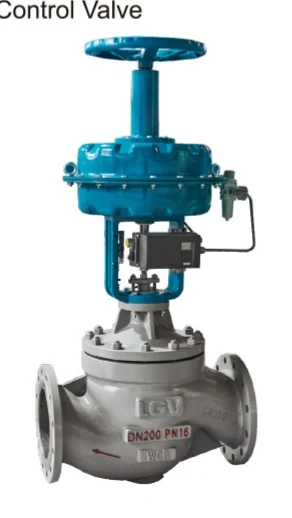
The retained hero image is matched to a Pneumatic Single-Seat Control Valve pictured in the source supplier catalog: PDF physical page 100, printed page 189 (bottom row, third product). It illustrates one control-valve construction, not a confirmed Flow Control Valves model number or a complete VALMORA order specification.
Confirmed illustration
The original catalog page identifies the depicted type as “Pneumatic Single-Seat Control Valve.” The existing image and source URL are retained. Visible markings or accessory appearance alone must not be used to set the offered rating, material or operating range.
Requires an identified offer
Obtain a named valve/trim configuration with the manufacturer’s applicable sizing output, Cv/Kv versus travel where available, characteristic, leakage/shutoff basis, allowable pressure drop, dimensional drawing, material schedule and actuator/accessory details. No general family-wide values are inferred here.
Required from the project
Supply the process cases, fluid properties, control objective, line connection, ambient/service constraints, specified fail action and applicable inspection or documentation requirements. A valve performance claim is not established by the quotation request itself.
Continue along the existing product structure
Need another valve type or application context?
If the duty is still uncertain, return to the broader control-valve category. Use the other links to compare valve families, service environments or technical guidance; they are navigation paths, not proof of a specific product configuration.
Browse Control Valves
Compare the control-valve families before selecting body style or actuation.
View all valve products
Move to a different valve family if the task is isolation, nonreturn or another duty.
Explore industry applications
Identify the service environment and process constraints before requesting sizing.
Read technical resources
Use technical explanations for context; rely on the offered product documentation for order approval.
Before requesting a quotation
Common flow-control specification questions
The questions below address different buying decisions. Specific performance and construction claims require the selected product documents.
Does a flow control valve automatically maintain constant flow?
No. A modulating valve changes its restriction in response to its actuator and control signal. Holding a flow setpoint as upstream or downstream pressure changes generally requires suitable flow measurement, a controller and a correctly sized valve. A self-operated pressure-compensated regulator is a different design and must be specified explicitly.
Why are minimum-flow and pressure-drop cases important?
A peak-flow point only checks one part of capacity. As operating flow and the available pressure drop change, the valve may work at very different travel positions. Provide paired flow, upstream pressure and downstream pressure for each case so minimum-load controllability and maximum-load capacity can both be reviewed.
Does the catalog photo establish a pressure rating or Cv/Kv?
No. The retained image corresponds to a Pneumatic Single-Seat Control Valve illustration on supplier catalog physical page 100 (printed page 189). It does not establish a VALMORA model-specific Cv/Kv, pressure/temperature rating, material, fail position or certification.
What should a comparable flow control valve quotation include?
Ask for the named valve and trim, sizing basis for the stated cases, offered body and end connections, materials, actuation and accessories, selected fail action, dimensions and applicable inspection/documentation list. Confirm any required tests and certificates against the actual order, not the series name.
Flow duty and order-specific review
Request a flow control valve selection review
Tell us the control objective, fluid, flow and pressures for the actual operating cases. Add any line, actuation or documentation constraints already known. The reply should identify the proposed configuration and what still needs confirmation; do not assume a catalog illustration is an approved specification.
- Minimum / normal / maximum flow with units and P1 / P2 for each case
- Fluid composition, phase, temperature and properties needed for sizing
- Control objective, range, response and required shutoff/leakage
- Line size, end connections, installation and face-to-face limits
- Control signal, available actuator utilities and required fail action
- Project standards, inspection/test and document deliverables
- Preferred manufacturer/product reference, quantity and delivery context
- Mark unknown process data clearly for engineering follow-up