
PDF-documented product
ASME Stainless Steel Check Valve
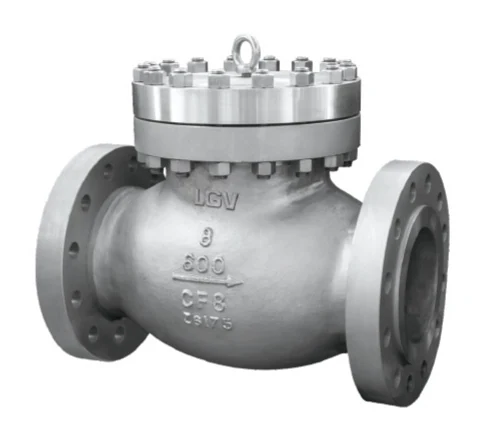
This catalog entry identifies an ASME Stainless Steel Check Valve for non-return service. Before specifying an offered valve, match the required flow direction and installation orientation with its internal closing mechanism. Check the minimum forward-flow differential, normal pressure loss, and the way the valve closes when flow slows or reverses. The catalog name alone does not establish a pressure class, ASME standard edition, or water-hammer performance.
- Valve type: Check Valve
- Material descriptor: Stainless steel
- Standard descriptor: ASME
Documented identity
What the catalog name establishes
The source catalog lists this product under the Check Valve series on PDF pages 82–83. It establishes the product name and pictured catalog entries, not an approved construction drawing or complete order specification.
Non-return function
A check valve is intended to allow forward flow and restrict reverse flow automatically. The required reverse-leakage limit and closing response must still be specified for the actual service.
Installation dependency
Permitted horizontal or vertical mounting depends on the exact disc or closure construction and its restoring forces. Do not assume every catalog image represents the same mechanism.
Source and standards boundary
The product appears on PDF pages 82–83. “ASME” is part of the catalog label; confirm the applicable standard number, edition, end-connection dimensions, and pressure–temperature rating on the offered datasheet.
Catalog evidence
Catalog-documented product data
The table records what the catalog label actually says. It does not confirm the internal construction, valve size, seat leakage, opening differential, ASME compliance, or any certified rating. Request the offered datasheet before treating those as order specifications.
| Field | Catalog-documented value | Evidence status |
|---|---|---|
| Valve type | Check Valve | VERIFIED — PDF catalog label |
| Material descriptor | Stainless steel | VERIFIED — PDF catalog label |
| Standard descriptor | ASME | VERIFIED — name only; edition and compliance unconfirmed |
| Catalog source series | Check Valve | VERIFIED — PDF catalog section |
| Catalog source page | PDF page 82; 83 | VERIFIED — recovered PDF mapping |
Important: values not shown in this table are intentionally unconfirmed. They must be resolved on the offered datasheet and approved order drawing.
Evidence boundary
Confirmed identity versus open performance data
The catalog establishes the name and matched exterior images. The parts that determine opening, pressure loss, leakage and closure timing are not established by the photographs. Request product-specific drawings and performance information for those decisions.
Confirmed by the catalog
- Valve type: Check Valve The PDF label identifies the valve type; it does not define the full configuration.
- Material descriptor: Stainless steel This describes the catalog product identity, not a complete body, trim and wetted-parts schedule.
- Standard descriptor: ASME The standard family appears in the product label; exact design, face-to-face and test editions require confirmation.
Confirm before quotation
- Internal closing element and any spring, gravity or other closing assistance
- Approved flow direction and horizontal / vertical mounting positions
- Minimum opening differential and stable minimum-to-maximum flow range
- Pressure drop at normal flow and documented closure response during reversal
- Pressure–temperature limits, exact body/trim/seat grades and end dimensions
- Seat leakage, inspection, material records, test scope and approved drawing
Engineering review
How to specify the ASME Stainless Steel Check Valve
Nominal size and the word “ASME” do not predict non-return behavior. Define the lowest forward-flow duty, the highest normal flow, and the event that could reverse flow. The supplier must show that the proposed mechanism opens stably, fits the mounting orientation, and closes acceptably for that event.
Non-return duty
For pump-discharge or equipment-protection duty, describe what reverse flow would damage or contaminate and what leakage is acceptable. If the pump can stop abruptly or the line has significant static head, request a transient/closing review; an ordinary check-valve label is not evidence of non-slam performance.
Operating envelope
Provide minimum, normal and peak flow (or flow velocity), normal differential pressure, design pressure, operating temperature and reverse-pressure case. If the available forward differential cannot reliably open the proposed valve, it may chatter or fail to establish the intended flow. Confirm opening requirements and pressure-loss data for the offered construction.
Materials and connection
“Stainless steel” does not establish a specific alloy grade or all wetted materials. Match the actual medium to the body, disc, seat and seals, then confirm the end style, face-to-face dimension, mating flange or pipe details, and applicable standard editions.
Closing mechanism and transients
Confirm whether closure is governed by gravity, a spring, flow reversal or a separate assisted device in the quoted valve. Ask how the element responds as flow decelerates. A check valve can limit backflow yet still allow reverse velocity to develop before seating, so water-hammer resistance must be assessed at system level.
Inspection and documents
Request the offered sectional/GA drawing, pressure–temperature data, material schedule, seat-leakage and pressure-test criteria, and installation instructions. Where pump trip or fast reversal matters, request evidence for the proposed closing response rather than inferring it from appearance.
Application boundary
Match the catalog identity to the real service
A valve that works in one piping arrangement may not be suitable in another. Confirm the actual fluid and operating cycle together with the orientation, available differential pressure, and reverse-flow event before choosing a construction.
Service medium
State the liquid or gas, composition, solids, viscosity, operating temperature and corrosion or erosion exposure. This controls both material selection and how deposits or debris could interfere with the closing element or seat.
Industry and system
Identify the equipment being protected and the operating sequence—for example, whether a pump trip, standby-pump start or pressure imbalance can create reverse flow. A steady-flow request alone does not establish the closing duty.
Installation boundary
Show the proposed line orientation and permitted flow direction on the P&ID. Obtain written confirmation that the quoted valve can operate in that position, with adequate access for installation and maintenance. Never infer vertical-down or vertical-up suitability solely from its catalog name.
Visual evidence
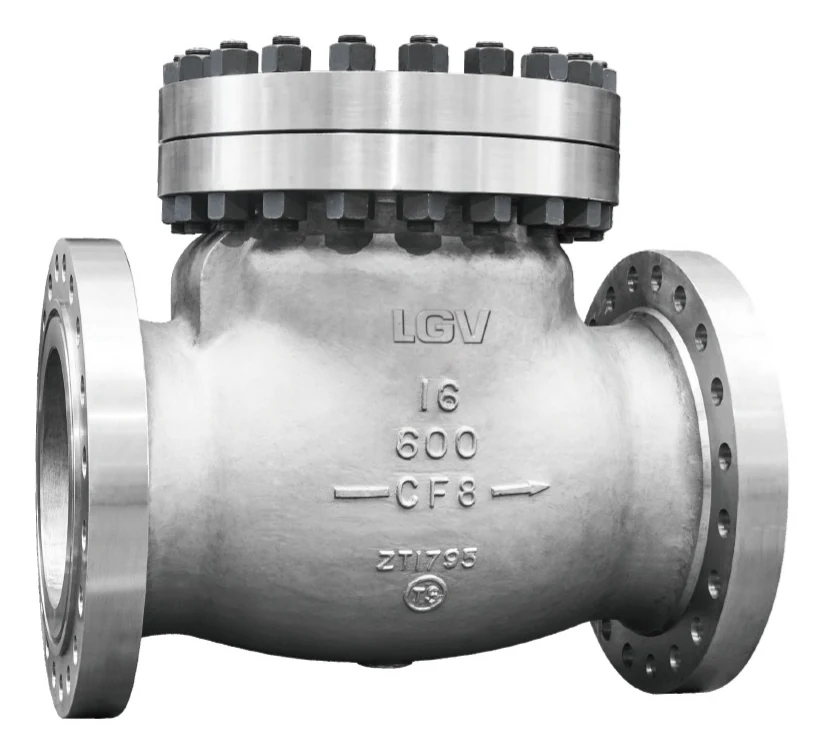
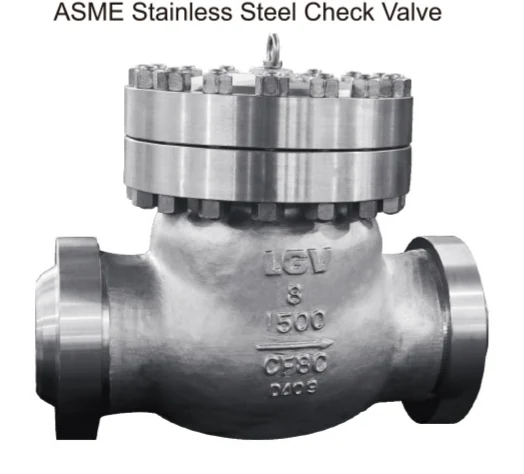
Catalog-matched stainless steel check valve views
These three catalog-matched views document the listed product identity, not a guaranteed internal mechanism or an as-supplied dimensional configuration. Installation and pressure–temperature decisions require the offered drawings and datasheet.
Related product routes
Compare documented alternatives before RFQ
Compare these separate catalog identities against the project standard and required closure behavior; do not transfer ratings or installation limits between them. For a broader explanation of check valve types, see the check valve technical guide.
GB Standard H44W Check Valve
GB-labeled H44W catalog record. Verify its actual standard basis, closing construction and service conditions separately before proposing a substitution.
GB Vertical Lift Check Valve
Vertical-lift-named catalog record. Request its approved installation direction and opening requirements; the name alone does not validate every vertical arrangement.
Wafer Forged Steel Check Valve
Wafer-forged-steel-labeled record. Compare connection geometry, material requirements and documented closure behavior against this stainless-steel entry.
Buyer questions
ASME Stainless Steel Check Valve FAQ
These answers distinguish catalog naming from the information needed to approve the actual installed valve.
Does “ASME” in the catalog name prove a pressure class or compliance?
No. The label does not identify a confirmed ASME standard number or edition, pressure class, or test certificate. Ask for the applicable project standards and the exact offered valve documentation.
Can this check valve be installed vertically?
Not from the catalog name alone. Orientation depends on the internal closure mechanism, flow direction and any closing assistance. Obtain the approved installation drawing for the offered valve.
Will this valve prevent water hammer after a pump trip?
Not necessarily. A check valve can restrict reverse flow, but a rapid closure after reverse velocity develops may create a pressure surge. Review the pumping transient and request closing-response evidence for the proposed construction.
What operating data should be included in the RFQ?
Provide the medium, minimum/normal/maximum flow, operating differential, design pressure and temperature, reverse-flow event, installation orientation, end connection, material requirements and required leakage, testing and documents.
Technical inquiry
Request a configuration review for ASME Stainless Steel Check Valve
Reference this catalog entry and describe the one-way duty, installation position and expected flow-reversal event. VALMORA can review an offered construction and identify the drawings and tests needed before a purchase decision.
- Service medium and the equipment being protected from backflow
- Minimum / normal / peak flow and available forward differential pressure
- Design pressure, operating temperature, end connection and material requirements
- Line orientation, flow direction, pump-stop / reversal conditions and required closing response
- Quantity, standard and edition, leakage / testing criteria and document requirements