
PDF-documented product
Stainless Steel High Pressure Gate Valve
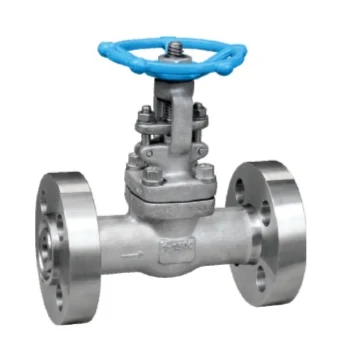
The supplier catalog identifies Stainless Steel High Pressure Gate Valve on PDF page 112. Its name and image establish the catalog identity, not a specified pressure-temperature rating, stainless steel grade or ready-to-order configuration. For an isolation duty, provide the process conditions and request an identified valve construction and technical offer.
- Valve type: Gate Valve
- Material descriptor: Stainless steel
- Pressure descriptor: High-pressure descriptor
Product identity
What this catalog record owns
This page represents one documented catalog identity. It does not replace the parent product category and it does not claim an unverified model, rating or project history.
Product family
Gate Valve. This is the parent commercial route for category-level selection.
Catalog series
Forged Steel Valve. This is the source-series context printed in the recovered product catalog.
Evidence source
Recovered source English product catalog, PDF page 112; mapped product image AST-R1-0462.
Catalog evidence
Catalog-documented product data
Only fields stated by the PDF catalog label are shown as product data. A descriptive term such as high pressure, large diameter or ASME does not create a numeric rating, orderable range or certification claim.
| Field | Catalog-documented value | Evidence status |
|---|---|---|
| Valve type | Gate Valve | VERIFIED — PDF catalog label |
| Material descriptor | Stainless steel | VERIFIED — PDF catalog label |
| Pressure descriptor | High-pressure descriptor | VERIFIED — PDF catalog label |
| Catalog source series | Forged Steel Valve | VERIFIED — PDF catalog section |
| Catalog source page | PDF page 112 | VERIFIED — recovered PDF mapping |
Important: values not shown in this table are intentionally unconfirmed. They must be resolved on the offered datasheet and approved order drawing.
Evidence boundary
Known facts and open configuration fields
The PDF proves the product label and mapped appearance. It does not by itself prove a complete bill of materials, operating envelope or order-ready model.
Confirmed by the catalog
- Valve type: Gate Valve The PDF label identifies the valve type; it does not define the full configuration.
- Material descriptor: Stainless steel This describes the catalog product identity, not a complete body, trim and wetted-parts schedule.
- Pressure descriptor: High-pressure descriptor The PDF provides a descriptive pressure term, not a numeric PN/Class rating.
Confirm before quotation
- Design / construction: confirm for the exact offered configuration
- Actuation: confirm for the exact offered configuration
- Size descriptor: confirm for the exact offered configuration
- Standard descriptor: confirm for the exact offered configuration
- Connection: confirm for the exact offered configuration
- Service / medium: confirm for the exact offered configuration
- Industry context: confirm for the exact offered configuration
- Temperature range and pressure-temperature limits
- Body/trim/seat details and material grades
- Testing, dimensions, certificates, price and lead time
Engineering review
Specify the duty before selecting the valve
For a high-pressure isolation inquiry, do not select by pressure designation alone. First specify the maximum design pressure together with the minimum and maximum design temperature; then verify the proposed pressure-boundary material, construction and rated pressure at those temperatures. Separately establish the maximum differential pressure across the gate during opening and closing, because it affects required operating force and operator selection.
Valve duty
Specify on/off isolation and the required shutoff performance, plus operating frequency and the highest differential pressure at which the valve must open or close. A gate valve should normally travel fully open or fully shut; for sustained throttling or frequent flow regulation, assess a suitable regulating valve instead. Confirm the proposed design can operate against the stated differential pressure.
Operating envelope
Provide design and normal operating pressures, minimum/normal/maximum fluid temperatures, startup and shutdown excursions, any vacuum or external-pressure conditions, if applicable, and maximum differential pressure during operation. Ask for the offered assembly’s allowable pressure at the specified temperature, rather than treating “high pressure” or a nominal Class/PN designation as a complete pressure-temperature rating.
Materials and connection
“Stainless steel” does not identify a grade or guarantee corrosion resistance. State the fluid composition and concentration, contaminants and temperature, then request an itemized body/bonnet, gate, stem, seat, packing and gasket material schedule. Confirm the mating flange/facing or weld-end geometry, dimensions and compatibility with the actual piping specification.
Actuation requirement
State handwheel, gear, electric, pneumatic or hydraulic preference, required opening/closing time and available utilities. For any proposed operator, require the valve supplier to establish the stem thrust/torque at the maximum specified operating differential pressure, with mounting and control interfaces defined. For powered actuation, specify the control interface and any required position or behavior on loss of utilities; ask the supplier to confirm whether that behavior is available. Do not assume an operator type or fail action is supplied from the catalog name.
Inspection and documents
Request a configuration-specific datasheet and general arrangement/section drawing showing size, bore, end details, stem clearance, bonnet and sealing arrangement. State the governing design and test specifications with editions, required pressure/seat test and acceptance criteria, material traceability, inspection hold points and records to be supplied. Document availability and compliance must be confirmed in the technical offer; the catalog image proves none of these.
Application boundary
When should this valve be shortlisted?
For isolation service, check three conditions together: the proposed pressure boundary must be rated for the actual design temperature and pressure; the wetted materials and seals must be compatible with the specified medium; and the valve/operator must be able to move against the required pressure differential. If any one cannot be documented in the offer, hold selection rather than infer suitability from the catalog label.
Service medium
Report fluid chemistry, concentration, temperature, chloride or other relevant contaminants, solids, deposits and cleaning or flushing conditions. A nominal stainless-steel designation alone does not establish compatibility with corrosive or erosive service; check each wetted and sealing material in the offered configuration.
Industry and system
Identify the plant, equipment and piping function. Industry naming alone is not enough to determine valve design or materials.
Installation boundary
Provide pipe orientation, available overhead clearance, access for the operator, end connection specification, line loads and ambient exposure. Compare these with the actual general arrangement and end details before releasing installation drawings. Do not assume a stem orientation or flow-direction rule without the offered design instructions.
Visual evidence
Mapped product images from the catalog
These images support product identity and appearance only. They do not establish dimensions, material grade, pressure rating, certification or the final supplied configuration.
Related product routes
Compare documented alternatives before RFQ
Use the parent category for commercial selection and these related catalog records for identity-level comparison. No page inherits specifications from another product.
Cryogenic Extended Stem Gate Valve
Another PDF-documented Gate Valve catalog record. Review its own evidence and configuration boundary.
Socket Weld Gate Valve
Another PDF-documented Gate Valve catalog record. Review its own evidence and configuration boundary.
Forged Steel Cryogenic Gate Valve
Another PDF-documented Gate Valve catalog record. Review its own evidence and configuration boundary.
Buyer questions
Stainless Steel High Pressure Gate Valve FAQ
These answers preserve the line between documented catalog evidence and project-specific selection.
What does the PDF catalog confirm for this product?
It confirms the product name Stainless Steel High Pressure Gate Valve, its source series Forged Steel Valve, the mapped product image and the catalog-label fields shown in the data table.
Which engineering conditions must an offer verify?
The offer must identify the pressure-temperature rating at the design conditions, maximum differential pressure allowed for operation, exact body/trim/seal materials, connections and operator sizing. Size, construction, applicable standards, dimensions, tests, certificates, price and lead time also require configuration-specific confirmation.
Can the catalog image be used as a final dimensional reference?
No. The image confirms catalog identity and appearance context only. Fabrication, installation and procurement must use the approved datasheet and order drawing.
What should be included in the RFQ?
Provide isolation duty and cycling frequency; fluid composition; design pressure and temperature range; maximum operating differential pressure; nominal size and end connections; required body/trim/seal materials; actuation and utilities; quantity; drawings; and test, inspection and material-document requirements.
Technical inquiry
Request a configuration review for Stainless Steel High Pressure Gate Valve
Reference catalog page 112 and supply your design pressure and temperature range, maximum opening/closing differential pressure, fluid chemistry, nominal size, piping ends, isolation duty and operating frequency. Include preferred actuation, quantity and required drawing, material and inspection records. VALMORA can then review a proposed configuration and document scope; the catalog label is not an approved equipment specification.
- On/off isolation duty, cycle frequency and process fluid composition
- DN/NPS, design pressure with minimum/maximum temperature, and maximum operating differential pressure
- Mating ends, specified body/trim/seat/packing materials and corrosion conditions
- Operator preference, available utilities, required travel time, control interface and required loss-of-utility behavior, if applicable, and sizing inputs
- Quantity, arrangement drawing, applicable specifications, tests and material/inspection records