
Globe Control Valves for Modulating Process Flow
Globe-style control valves regulate flow by moving a plug toward or away from a seat. They are a starting point for modulating liquid, gas and steam service where the required flow range, available pressure drop and control response justify a linear-stem design. Choose the body, trim and actuator from actual operating cases—not pipe diameter alone.
Start with the duty: minimum, normal and maximum flow; corresponding inlet and outlet pressures; fluid properties; and the required failure action. Review the catalog example below, then request a configuration-specific sizing and documentation response.
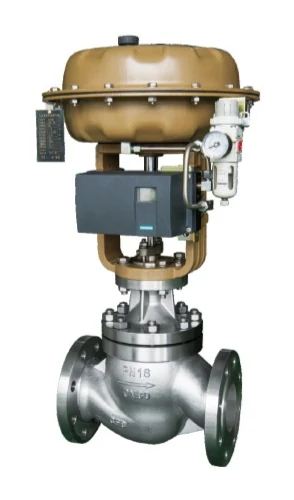
Catalog-pictured pneumatic diaphragm control valve
The supplier catalog shows several distinct control-valve constructions. The photograph here corresponds to a Pneumatic Diaphragm Control Valve on the original control-valve spread. The adjacent Pneumatic Single-Seat Control Valve is a separate catalog entry and must not be identified by this gold-actuator photograph.
The pictured assembly has a diaphragm actuator above a flanged valve body. The image does not establish its flow coefficient (Cv/Kv), trim construction, seat leakage, rated pressure-temperature envelope, materials, or included controls. Open the individual product record for its own evidence and quotation fields.
When should you start with a globe-style control valve?
A globe-style throttling valve can provide a controlled linear plug movement and trim choices for a specified duty. It is not automatically the best option for every fluid or piping layout: compare the required low-flow control, pressure loss, phase behavior and body pattern before selecting the valve style.
Modulating flow with a wide duty range
Start with a globe-style plug-and-seat design when stable adjustment between low and high operating flow is important. Check the installed characteristic and predicted opening at each duty point; a large line-size body with excessive Cv may control poorly near shutoff.
When rotary control is worth comparing
A V-port ball valve uses a rotary characterized port rather than linear plug travel. Compare its available trim, handling of the actual fluid, required range and actuator arrangement; the page name alone is not proof of solids tolerance or low leakage.
Is the task really regulation?
A manually operated globe stop valve is not automatically a complete actuated control assembly. If the duty is periodic isolation rather than a control loop, review Globe Valves. If the duty is modulation, specify the actuator, control signal, trim and required response; flow-path or severe-service variants must be evaluated individually.
Size the globe valve against the full operating range
At high flow with little available pressure drop, more flow capacity may be required; at minimum flow with a larger pressure drop, an oversized trim may operate too close to its seat for stable control. Request a predicted Cv/Kv and valve travel at each duty point, not a single nominal flow rating. For applicable fluids, the sizing basis may use IEC 60534-2-1; that standard does not certify or size any VALMORA product by itself.
| Check | Data to send | What it decides |
|---|---|---|
| Minimum / normal / maximum | Minimum, normal and maximum flow with units and the corresponding P1/P2 for each case; identify pressure values as gauge or absolute. If gas/vapor flow is volumetric, specify actual or standard volume and, for standard volume, its reference temperature and pressure. Include startup conditions if relevant. | Compare calculated Cv/Kv and expected valve opening across all cases; screen oversizing at minimum flow |
| Liquid phase / pressure drop | Liquid temperature, density, vapor pressure and downstream pressure; identify mixed phase, solids or slurry | Review cavitation, flashing, choked flow and trim erosion risk before selecting materials or capacity |
| Flow characteristic | Control objective, system pressure-loss variation, allowable hunting, requested shutoff | Review installed versus inherent characteristic, trim/seat choice and leakage requirement |
| Actuator and accessories | Instrument-air range or electric supply, control signal, required fail position and speed | Match required thrust, packing/seat load, differential pressure, positioner and accessories to the valve |
| Pressure boundary and interfaces | Design P/T, fluid chemistry, flange/end standard, line size/schedule and available clearance | Confirm rated body/bonnet/ends, dimensions, corrosion resistance and the applicable document set |
Three operating situations that change selection
These are engineering screening choices, not claims that the catalog image includes special trim or guaranteed performance.
Low-flow instability
If the required minimum flow would put the proposed plug near its seat, ask for a reduced-capacity trim or a different valve size and compare the predicted installed travel. Do not increase capacity simply to match the pipe bore.
Liquid cavitation or flashing
For liquid service, compare the valve pressure profile with the fluid vapor pressure. Cavitation can occur when local pressure falls below vapor pressure and subsequently recovers; when downstream pressure remains below vapor pressure, flashing persists. Confirm the duty-specific mitigation and trim availability rather than assuming a standard globe trim solves either case.
Gas, steam or hot service
Check compressible-flow capacity, possible choking, predicted noise and outlet velocity. For temperature-control service, define the control-loop objective and response, then verify actuator thrust, bonnet/packing temperature suitability and instrumentation interfaces.
Avoid four specification shortcuts
A comparable offer needs more than a nominal size and a product photo. These errors can alter both the valve and the actuator proposal.
- Pipe diameter is not calculated Cv/Kv: an oversized valve may spend normal operation at very low travel.
- One normal flow case misses the high-flow capacity and low-flow controllability extremes.
- A photograph or catalog label cannot establish leakage class, trim capacity or severe-service suitability.
- Fail-open, fail-closed or another failure response must follow the process hazard assessment and the specified actuator/accessories.
Compare complete valve-and-actuator proposals
Ask each supplier to quote against the same operating cases and clearly identify its proposed assembly. The original catalog establishes a product name and illustration, not the final configuration or included test records.
Sizing and trim
Request the exact body/trim identification, flow characteristic, calculated required and selected Cv/Kv, predicted travel for key cases, seat leakage requirement, and any cavitation/noise assessment. Review assumptions alongside the numbers.
Actuation and instrumentation
Identify actuator type and sizing basis, air supply or power, fail action, positioner, solenoid and feedback options. Confirm which are included in the offer rather than relying on accessories visible in a photo.
Materials, dimensions and records
Compare design pressure-temperature limits, body/bonnet/trim/packing materials, connection dimensions, approved drawing and the required inspection, pressure/seat-test and material documents. Confirm standards and document availability for the offered configuration.
Continue to the right valve or technical record
For a wider comparison of modulation and actuator types, start at Control Valves. For other functions browse all valve families; industry service context is available under Industries. These navigation pages do not replace a verified product datasheet.
Pneumatic diaphragm catalog product
Check the individual catalog record for the photographed pneumatic diaphragm control valve; its specification must be reviewed on its own merits.
Compare V-port ball control
Use the separate rotary characterized-port route to compare trim and actuator selection for the same duty.
Browse all control valves
Return to the parent range for electric, pneumatic, angle and other control-valve constructions.
Read technical resources
Use application and valve-principle guidance as background; obtain sizing and product documentation for the actual offer.
Globe control valve selection questions
Use the operating cases and the specific offered trim—not the illustrated actuator—to settle these points before order approval.
Why is the nominal line size not enough to choose a globe control valve?
Flow depends on available differential pressure, fluid properties and the selected flow coefficient. Compare calculated Cv/Kv and predicted travel at minimum, normal and maximum duty rather than assuming a full-bore, line-size valve will control well.
Does the pictured pneumatic diaphragm valve define all available globe configurations?
No. The original catalog picture identifies a pneumatic diaphragm control-valve entry. It does not confirm a complete globe product range, a specific body/trim or the size, pressure rating, leakage class, accessories and standards for an order.
What changes if the liquid service risks cavitation or flashing?
Check fluid vapor pressure against the pressure conditions. Cavitation and persistent flashing are different regimes and may require different valve geometry, trim and materials. Request a case-specific assessment before accepting a severe pressure-drop duty.
What should be included in a globe control valve RFQ?
Send flow and corresponding inlet/outlet pressure at all operating cases, fluid properties and temperatures, design conditions, control objective, fail action, instrument supply, piping interfaces and requested tests or records. Ask for a sized configuration and drawing.
Request a globe control valve sizing and quote review
Send available operating cases and project specifications. A quotation should identify the proposed valve and actuator assembly, the sizing assumptions, pressure boundary and approval documents. Mark unknown inputs clearly; do not replace them with estimated manufacturer ratings.
- Minimum / normal / maximum flow with units and matching P1/P2 (gauge or absolute); for gas/vapor volumetric flow, state actual or standard basis and standard reference conditions.
- Fluid phase, density, viscosity, composition, temperature and vapor pressure where relevant
- Design pressure and temperature, shutoff differential and installation conditions
- Control objective, installed characteristic, leakage and noise limits
- Required failure action, air/power supply, signal and positioner/accessory needs
- Pipe DN/NPS, end and facing standard, space and orientation
- Requested standards/editions, test criteria, drawings and material records
- Quantity and project reference; unknown details clearly marked