
Y-Pattern Globe Valves
A Y-pattern globe valve keeps the inlet and outlet on the same pipe axis while inclining the seat and stem to create a more direct flow path. It can reduce full-open pressure loss compared with a conventional straight-pattern globe valve, but the actual benefit depends on the selected valve and operating flow. Compare the design, pressure–temperature rating, closure duty, and installation envelope before specifying a product.
Start here: Decide whether an in-line Y-pattern design suits the piping and duty. Then use the offered drawing and flow data to confirm the exact configuration.
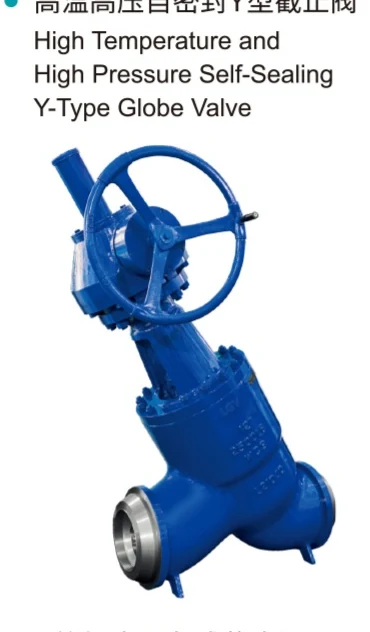
Catalog example: High Temperature and High Pressure Self-Sealing Y-Type Globe Valve, handwheel-operated.
Y-pattern vs. straight-pattern and angle globe valves
All three use a disc closing against a seat, but the pipe routing and internal flow turns differ. Choose the body arrangement for the line first; then check the actual size, trim and valve performance.
Y-pattern: in-line with an inclined seat
Both pipe ends remain in line. The inclined seat and stem generally give a less tortuous fully open path, making this pattern worth comparing when pressure loss matters and a globe-type closure is required.
Straight-pattern: in-line with more flow turns
A conventional Z-body globe valve also fits a straight run, but flow typically turns more sharply around the seat. It can still be the better choice when its actual shutoff, throttling characteristics, dimensions or maintenance arrangement fit the duty.
Angle-pattern: a 90° pipe turn
An angle globe valve changes the line direction through the valve and may replace a separate elbow. It is not a direct layout substitute for the in-line Y-pattern valve. Compare angle globe valves.
When does a Y-pattern design make engineering sense?
Start with the piping geometry and required function. An inclined flow passage can help at full opening; it does not by itself prove a specified Cv/Kv, acceptable throttling behavior or an operating pressure limit.
| Project condition | Selection decision | Required evidence |
|---|---|---|
| An in-line run with limited allowable loss | Shortlist a Y-pattern globe valve against an equivalent straight-pattern design. | Compare actual Cv/Kv or pressure-drop data at the design flow and valve position; equal nominal size alone is not enough. |
| A pipe route that must turn 90° | Review the angle-pattern family before selecting an in-line Y-body. | Check installed end geometry and whether removing an elbow truly fits the spool drawing. |
| Frequent throttling or high differential pressure | Select trim and actuator around controllability, erosion and required shutoff, not body shape alone. | Ask for the operating-position flow curve, differential-pressure range and any cavitation, flashing or noise assessment relevant to the fluid. |
| High-temperature or pressure-cycling service | The catalog illustrates a self-sealing Y-type example; verify the required bonnet and sealing arrangement for the offered unit. | Check material-specific pressure–temperature limits, seat/packing specifications, test scope and flow direction on its datasheet. |
| Restricted operating or maintenance space | The angled stem may change access and removal clearance compared with a vertical stem. | Request installed dimensions, handwheel/actuator envelope, support points and maintenance removal space. |
What changes with the operating duty?
The value of the Y-pattern flow path depends on how the valve operates: fully open most of the time, regulating flow, or cycling between positions. These duties lead to different trim and document requirements.
Steam and thermal service
An in-line Y-pattern layout can be considered where full-open loss and closure duty both matter. Review maximum and minimum operating temperatures, design pressure, thermal cycling, packing and bonnet sealing; the photo does not establish a temperature rating.
Bypass and intermittent operation
If the valve stays mostly open, compare full-open loss and shutoff requirements. If it repeatedly operates partly open, request operating-point data and trim suitability; sustained throttling or erosive flow cannot be approved from the Y-shaped body alone.
Space-constrained piping
Use a Y-pattern body when the end-to-end pipe route must stay straight; check the angled bonnet and handwheel clearance against supports and surrounding equipment. Where the route turns at the valve, assess an angle globe valve instead.
The catalog example and the data a quote still needs
The globe-valve catalog names the pictured blue handwheel valve “High Temperature and High Pressure Self-Sealing Y-Type Globe Valve.” An Electric Y-Type Globe Valve appears separately on the same catalog spread. The two illustrations identify different configurations, not one universal size, pressure rating, material or actuator package for the series.
Illustrated construction
The pictured handwheel-operated example has an inclined bonnet and aligned pipe ends. The catalog label identifies it as a self-sealing Y-type design; the image is not a dimensioned approval drawing.
To specify the offered valve
Request the valve datasheet and general-arrangement drawing with nominal size, connection details, pressure class, body/trim materials, bonnet construction, flow arrow and installed envelope. Compare the pressure–temperature rating at the actual service temperature.
To assess performance and acceptance
Provide operating flow and pressure cases, closure or regulation duty, leakage requirement and applicable project standards. Ask which flow data, tests, material records and inspection documents can be supplied for the quoted configuration.
Choose the next product page
This page covers the Y-pattern body arrangement, not every globe-valve configuration. For broader browsing, see all valve products; for duty context, see industries; and for general technical background, see resources. The links below take you to a distinct product selection task.
Globe Valves · parent category
Compare the full globe-valve family, including straight, angle, bellows-seal and Y-pattern routes.
Electric Y-Type Globe Valve
Open the separate catalog product for actuator-related requirements; an electric operator is not a standard feature of every Y-pattern valve.
Angle Globe Valves
Compare a 90° valve body for a pipe turn rather than an in-line Y-pattern flow path.
Bellows-Seal Globe Valves
Explore a different stem-sealing design when external leakage control is a central specification issue.
Y-pattern globe valve selection FAQs
These answers address the valve body pattern and purchasing process. Quoted limits and final acceptance criteria belong to the identified product and purchase documents.
What is the practical difference from a straight-pattern globe valve?
Y-pattern and conventional straight-pattern globe valves both keep the line connections aligned. The inclined seat and stem of a Y-body generally allow a more direct full-open flow path. For a project decision, compare actual flow coefficients and installation dimensions for the products under consideration.
Does the pictured self-sealing Y-type valve define the whole series?
No. The catalog identifies one high-temperature, high-pressure self-sealing Y-type example. It does not publish one universal range of sizes, pressure classes, materials, bonnet joints or temperature limits for all Y-pattern configurations.
Is an electric actuator part of every Y-pattern valve?
No. The catalog separately names an Electric Y-Type Globe Valve. Follow that product entry for an electrically operated configuration and confirm actuator supply, power, control interface and fail-position requirements in the quotation.
What is needed before a Y-pattern valve can be approved?
Provide the medium, line size and ends, design and operating pressure–temperature cases, flow or differential-pressure duty, shutoff requirements, installation envelope and project documentation needs. Ask for the exact datasheet, dimensional drawing, materials, applicable test scope and quotation-specific exclusions.
Request a Y-pattern globe valve configuration review
Send the known duty and piping details. If the supplied information is incomplete, identify which values are still being established. The response should identify the offered valve and documents rather than treating the catalog illustration as an approved specification.
- Required function: isolation, intermittent regulation or throttling
- Medium, design/operating pressures and temperatures, including differential pressure
- Medium, composition, phase and solids where relevant
- Line size, end connection, applicable piping standard and layout
- Flow cases, allowable pressure drop and shutoff/leakage requirement
- Manual or electric operation, access limits and installation orientation
- Material/trim requirements and project inspection or documentation needs
- Quantity and required delivery location; request quote-specific confirmation