
PDF-documented product
PTFE Lined Angle Globe Valve
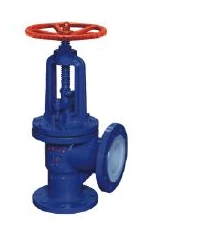
The supplier catalog lists a PTFE Lined Angle Globe Valve and shows an angled body with side and bottom connections. Consider this catalog item when your line needs a change in direction and a lined valve for a defined process medium. The catalog does not establish its orderable sizes, complete wetted materials or permissible pressure–temperature range.
- Body pattern: angle globe valve (catalog label and photograph)
- Lining designation: PTFE lined (coverage and construction not specified)
- Documented source: Anti-corrosion Valve Series, physical PDF page 110
Catalog evidence
Identify the angle-pattern product
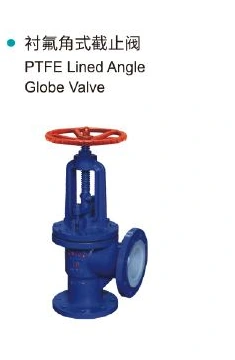
The original catalog places this item in the Anti-corrosion Valve Series. Its printed name and adjacent product photo are distinct from the straight-pattern PTFE Lined Globe Valve. This page documents that specific identity; configuration and supply conditions require a project quotation.
Valve family
Catalog grouping
The source lists this product within its Anti-corrosion Valve Series, not as a verified chemical-resistance or temperature rating.
Direct visual source
Supplier product catalog, physical PDF page 110 (printed page 209–210). The corrected blue-body product crop and label both come from the same page.
Catalog evidence
Catalog-confirmed product details
The table reports only the printed identity. The catalog page does not give an individual dimensional drawing, rated pressure, body and trim material list, Cv or available actuator options for this item.
| Attribute | Catalog evidence |
|---|---|
| Product name | PTFE Lined Angle Globe Valve |
| Valve pattern | Angle body with side and bottom ports shown in the product photograph |
| Lining designation | PTFE lined; affected wetted surfaces and thickness not listed |
| Catalog grouping | Anti-corrosion Valve Series |
| Source page | Physical PDF page 110 (printed pages 209–210) |
Evidence boundary
What can be selected now?
The catalog establishes a possible body pattern, not an approved service envelope. Use the process conditions to decide whether to request an angle-pattern quotation or a different design first.
Good reason to evaluate this pattern
- Your piping needs an angled connection rather than two in-line flanges.
- A PTFE-lined construction is being considered for a specified process fluid.
- You can provide the fluid composition and service conditions for review.
Reasons to pause or change the request
- For an in-line pipe run, compare the straight-pattern PTFE Lined Globe Valve before specifying an angle body.
- For continuous modulation, request trim, Cv/flow curve, differential-pressure and lining/seat erosion evidence; this catalog picture alone does not establish throttling duty.
- For corrosive, hot, vacuum, abrasive or cyclic service, do not assume compatibility from the PTFE name. Ask for the full wetted-material list and service limits.
Engineering review
Specify the service before choosing a configuration
An RFQ should define both the piping geometry and the chemical/thermal duty. If either is unknown, request a technical assessment rather than selecting a pressure class or seat arrangement by analogy with another valve.
Isolation or control?
For infrequent open/close duty, give the required shutoff performance and cycling frequency. For throttling, provide minimum/normal/maximum flow, inlet/outlet pressures and allowable pressure drop; do not assume the listed valve has a control trim or published Cv.
Fluid and pressure–temperature envelope
State the chemical name, composition and concentration, contaminants/solids, operating and design pressure, minimum and maximum fluid temperature, and any vacuum or pressure surge. Material compatibility and allowable pressure must be checked for this exact valve construction at the stated temperature.
Port layout and mating connections
Submit DN/NPS, desired inlet and outlet directions, flange standard and facing, mating pipe details, available installation space and requested flow direction. The picture shows an angled body, but no bolt pattern, face-to-center dimension or installation orientation is documented here.
Liner, trim and actuator scope
Ask for confirmation of the lining grade and thickness, which wetted surfaces are protected, body and bonnet material, seat/disc/stem materials, and the pressure–temperature limits of the assembled valve. The photo shows a handwheel; it does not prove that other actuators can be supplied.
Approval documents and quantity
State quantity and request the offered datasheet, dimensional drawing, material/lining details, applicable pressure and leakage test scope, and any project-specific inspection or certification. Confirm actual availability and delivery terms in the quotation.
Visual evidence
The catalog label and the correct product image
The catalog labels the blue, angle-body valve as “PTFE Lined Angle Globe Valve.” The neighboring silver, straight-pattern valve is a different item. Neither image is a dimensioned drawing or a complete material specification.
Related product routes
Compare the correct product family
Choose by port geometry first, then confirm the lining and duty. The pages below cover different selection tasks and do not share unverified ratings.
PTFE Lined Globe Valve
Compare this separately labeled straight-pattern valve when the piping run is in line.
Angle Globe Valves
Compare angle body patterns and the application-level selection criteria in the dedicated series.
Lined & Anti-Corrosion Valves
Browse lined valve mechanisms when corrosion protection is a primary requirement.
Technical inquiry
Request the PTFE-lined angle globe valve configuration
Reference the catalog product and send your service conditions. VALMORA can check the offered materials, dimensions, duties and documentation before quotation; the catalog picture is not an approved specification.
- Fluid identity, composition/concentration, operating/design pressure and minimum/maximum temperature
- Duty: on/off or throttling; flow and differential pressure if control is requested
- DN/NPS, inlet/outlet orientation, flange standard/facing and available clearance
- Lining/wetted-parts requirements, handwheel or requested actuation, and any vacuum/solids
- Quantity, delivery location, drawings, material records and test/inspection requirements