
Gate valve · catalog-listed configuration
ASME Stainless Steel Gate Valve
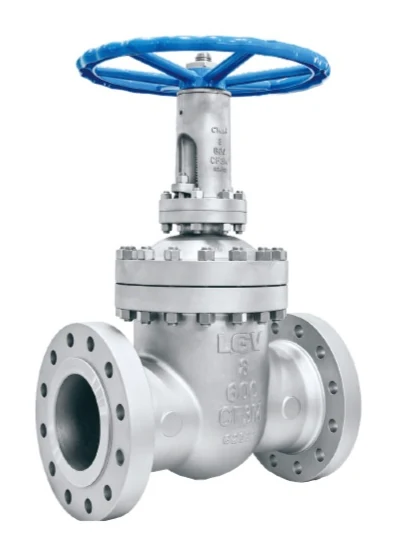
The catalog labels this product ASME Stainless Steel Gate Valve and shows a handwheel-operated valve with flanged ends. It is a starting point for an on/off isolation inquiry—not a confirmed pressure class, material grade, or dimensional specification.
Send the medium, size and design conditions to request an offered datasheet and a dimensional drawing before specifying the valve.
- Function: gate valve for on/off isolation review
- Catalog descriptor: stainless steel (grade not stated)
- Pictured arrangement: handwheel and flanged ends; exact standards to confirm
Catalog product details
What the catalog confirms—and what it does not
The source catalog identifies this gate valve by name on PDF page 77 (printed pages 143–144). Its photograph shows a flanged, handwheel-operated arrangement. No size schedule, body grade, pressure–temperature rating, flange drilling or test class is provided for this item in the supplied catalog excerpt.
| Attribute | Catalog evidence | What to use for procurement |
|---|---|---|
| Catalog designation | ASME Stainless Steel Gate Valve | Product identity; not a manufacturer model number |
| Valve function | Gate valve family | Specify isolation duty; confirm required shutoff performance |
| Material | “Stainless steel” appears in the product name | Request exact body, bonnet, trim and wetted-part grades |
| Operator shown | Handwheel visible in catalog photo | Confirm offered actuation and operating torque |
| Ends shown | Flanged ends visible in catalog photo | Obtain flange dimensions, facing, drilling and face-to-face drawing |
| ASME designation | “ASME” appears in the product name | Specify required standard number and edition; obtain evidence of conformity for the offered configuration |
| Pressure, temperature and size | Not stated for this item in the supplied catalog excerpt | Require a configuration-specific datasheet and pressure–temperature rating |
Procurement boundary: the photo is not a dimensional drawing, and an “ASME” product name is not proof of compliance with a particular ASME standard. Use the supplier’s offered datasheet and approved drawing for ordering and installation.
Engineering selection
Is this gate valve right for your line?
Start with the required valve function. If the line needs normal open/closed isolation, develop the specification below. If it needs sustained flow modulation, use a valve designed for throttling instead of relying on a partly open gate.
Isolation duty comes first
Gate valves are generally intended to operate fully open or fully closed. Holding a gate partially open for throttling can accelerate seat and wedge wear. For sustained flow regulation, compare a globe valve or a suitable control valve before issuing an RFQ.
Evaluate pressure and temperature together
Provide design and normal pressures, minimum and maximum temperatures, surge/vacuum cases and nominal size. Do not treat an ASME Class or PN designation as the allowable pressure for every material and temperature; request the offered valve’s material-based pressure–temperature rating and applicable code edition.
Match the material to the fluid
“Stainless steel” does not identify a grade or guarantee suitability for a fluid. State composition, concentration, temperature, solids and cleaning exposure; ask for a body/bonnet, stem, wedge, seat, packing and gasket material schedule before accepting the configuration.
Verify the flange interface and installation space
If the mating flanges are already specified, provide their standard, ASME Class or PN designation, facing and drilling alongside the line’s design pressure and temperature. Verify the offered flange dimensions, gasket, face-to-face length and pipe alignment against an approved drawing. Check operator and maintenance clearance without imposing unsupported piping loads.
If the offered design or service imposes an installation orientation or required flow direction, identify it in the RFQ and verify it against the approved drawing and the offered valve’s installation instructions; do not infer such a restriction from the photograph.
Specify operation, inspection and records
The photograph shows a handwheel; it does not prove other operators are offered. State cycling frequency and operator preference, and request applicable torque data. Specify required pressure and seat tests, material documentation, traceability and test records. If the project calls for third-party witnessing or inspection hold points, identify these separately in the RFQ; no witnessing or certificate is presumed.
Related configurations
Other gate valve configurations to compare
If the project requires a larger line size or powered operation, compare these separately documented catalog records. None of their dimensions, materials or ratings automatically applies to the stainless steel valve on this page.
Large Diameter Electric Gate Valve
Review when the key requirement is a large-bore valve with electric operation. Verify its own size and rating data.
ASME Large Diameter Electric Gate Valve
Review for an ASME-named, large-diameter electric configuration. The title alone does not certify a particular code or edition.
ASME Large Diameter Gate Valve
Review an ASME-named, large-diameter alternative when remote electric operation is not the main selection criterion. Confirm its operator and sizes separately.
Get a configuration-specific quote
Request a datasheet and quotation
Reference the ASME Stainless Steel Gate Valve on catalog page 77. Attach your piping specification or duty sheet if available and state the required delivery date in the inquiry or accompanying document. Ask the supplier to confirm the actual lead time. The quotation should identify a specific construction and include the offered dimensions, material schedule, pressure–temperature data and agreed inspection scope.
- Required duty: on/off isolation, medium, concentration and solids
- Nominal size, design/operating pressure, temperature range and surge/vacuum cases
- If the mating flanges are fixed: standard, ASME Class or PN, facing, drilling and face-to-face requirement
- Required body/trim/seat grades, packing and corrosion constraints
- Quantity, required delivery date, technical documents, test records and any third-party witness/hold points