
PUMP DISCHARGE · NON-SLAM CHECK VALVE SELECTION
Silent Check Valves for Pump Shutdown and Non-Slam Duty
In a pump-discharge line, a properly selected spring-assisted, center-guided check valve can start closing as forward flow decays, limiting the reverse velocity that can make a check valve slam. “Silent” is a design objective, not a zero-noise or zero-water-hammer guarantee. Pump trip behavior and the pipe system still determine the surge risk.
Start with minimum and normal flow, allowable pressure drop, shutdown sequence, line profile, and installation direction. A specific offered model, spring arrangement, opening characteristic and dynamic response must be verified before specification.
FIRST SELECTION QUESTION
Does reverse flow develop quickly after the pump stops?
If yes: evaluate a short-travel spring-assisted candidate and ask how its disc closes as flow decelerates.
If flow is often low: first check whether the proposed disc stays fully and stably open.
If the line contains solids: assess guided-part blockage risk before selecting this construction.
CLOSING DYNAMICS & FLOW STABILITY
When does a silent check valve reduce slam risk?
First decide whether reverse velocity can build before closure. After a pump trip, forward flow decelerates; a long-travel, unassisted disc may not seat until some reverse flow develops. A short-travel spring-assisted design can reduce that delay, but its actual response must be matched to the pump inertia, pipeline profile and allowable transient pressure. A sudden deceleration elsewhere in the system can still produce water hammer.
| Selection question | Required project data | Practical decision |
|---|---|---|
| Pump stop / flow reversal | Pump trip sequence, pump inertia, system profile and rate of flow decay | If reverse flow can build before closure, screen a short-stroke, spring-assisted design and obtain model-specific dynamic evidence. |
| Low-flow opening stability | Minimum / normal / maximum flow, nominal size and fluid properties | Exclude a candidate that cannot stay stably open at minimum flow; compare its opening behavior and pressure-loss curve, not just line size. |
| Head loss and capacity | Available differential pressure, required flow, offered Cv or head-loss curve | A design that closes favorably but consumes excessive head is not an acceptable selection. |
| Fluid and installation | Solids content, temperature, orientation, straight-run conditions and access | Do not assume a guided design handles solids or every installation direction; verify the offered model and instructions. |
| Project acceptance | Permitted surge, reverse flow, leakage and test/document requirements | If transient consequences are serious, seek a system surge study and a stated technical acceptance basis before ordering. |
WHERE THE DESIGN HELPS · WHERE IT DOES NOT
Match closure response to the actual operating duty
Use the operating case to screen the configuration, rather than specifying “silent” from the name alone. Three conditions change the shortlist:
Pump trip and rapid flow reversal
When a pump stops and the line rapidly tends toward reverse flow, a short-stroke spring-assisted candidate is worth evaluating. Ask for pump trip/deceleration data, closing characteristics and surge assessment where consequences are high. A generic fast-closure claim is not a transient calculation.
Low or variable flow
A valve sized only to nominal pipe diameter can remain partly open at low duty flow. Disc flutter and wear may follow. Compare minimum, normal and peak flow with the offered valve’s stable-opening range, Cv/pressure-loss data and spring setting. If minimum flow cannot keep the disc stable, change the size/design before ordering.
Solids or critical system duty
Clean-fluid, center-guided designs can be inappropriate where solids may lodge in the guide or seat. For dirty service, assess a different internal geometry and documented solids tolerance. For safety-critical lines, include the system transient analysis, isolation requirements and failure consequences in the design review.
COMPARE ACTUAL CLOSURE MECHANISMS
How silent, axial, lift, swing and quick-closing differ
Silent, axial-flow, lift, swing and quick-closing are not interchangeable labels. A spring-assisted center-guided disc typically makes a short linear closing stroke; “axial flow” alone does not certify any particular spring response. A conventional lift check uses guided motion but may rely on pressure differential or gravity. A swing check pivots on a hinge; its closure can permit reverse velocity to develop. “Quick-closing” describes an intended response but may use a different mechanism or control arrangement. Choose by the offered construction and operating duty.
For high-head pump systems, a pressure-surge assessment may be necessary even with a non-slam check valve: preventing disc slam is not the same as eliminating every hydraulic transient.
- Spring-guided short-stroke closure needs the offered model drawing or test record.
- “Silent” does not promise zero noise, zero surge or a particular closing time.
- Axial-flow layout is not the same as a verified non-slam response.
- Minimum stable flow, pressure drop and permitted installation direction can reject a candidate.
CATALOG IMAGE IDENTITY · IMPORTANT DISTINCTION
Catalog cross-reference: tilting-disc is not a silent check valve
In the supplied catalog’s physical PDF page 81, the Axial Flow Check Valve is on the left and the Tilting Disc Check Valve is on the right. The retained product image shows the right-hand tilting-disc valve. It is a comparison reference, not a photograph or specification of a silent check valve. No orderable silent-check model or performance curve is established by these pages.
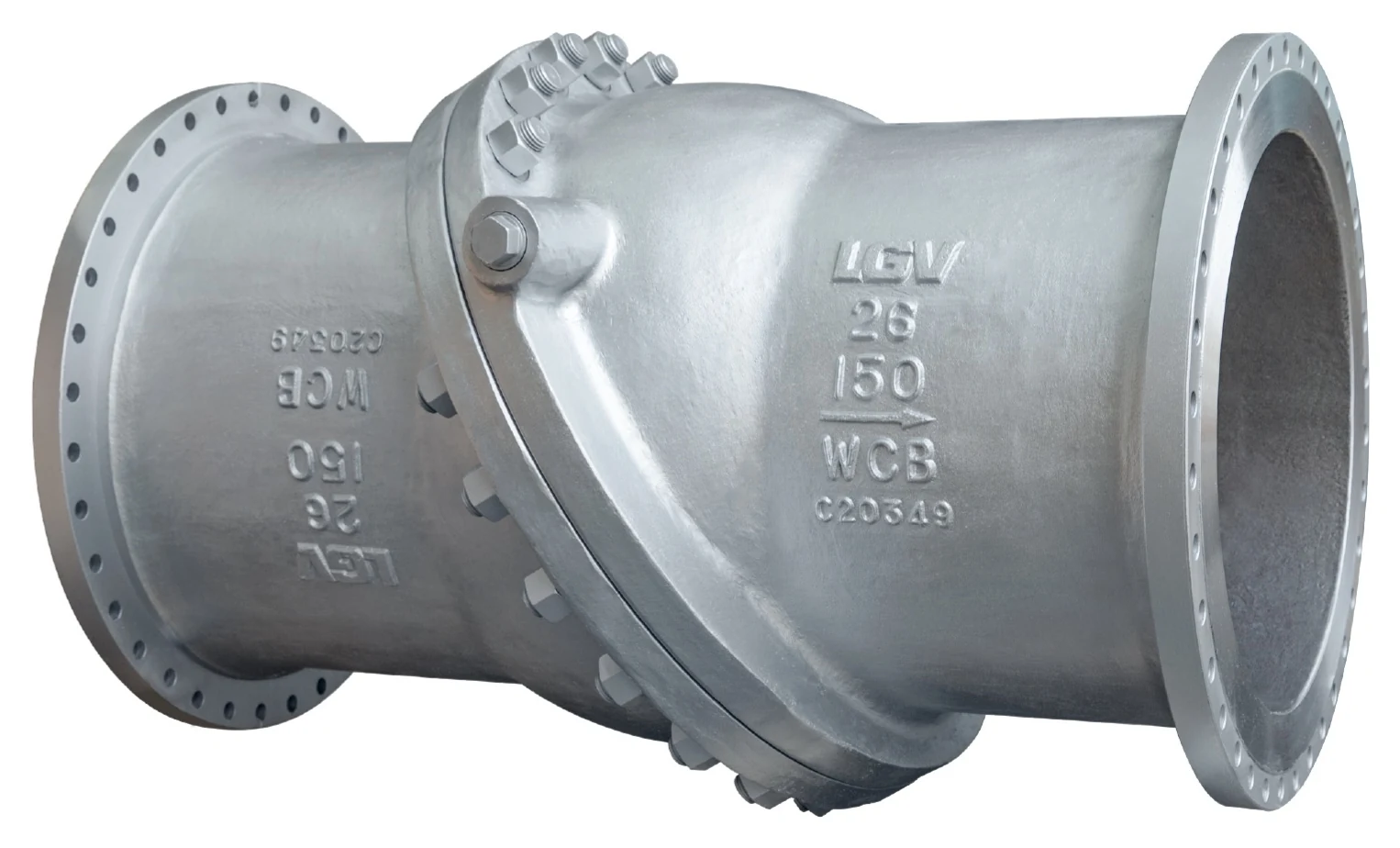
This image documents a tilting-disc configuration, whose pivoting closure differs from a spring-guided, short-stroke silent check arrangement. Do not infer spring details, materials, leakage class, response time or installation suitability from the image or cast markings.
Primary evidence: original supplier check-valve catalog, PDF physical page 81 (printed spread 151–152). Use the catalog for valve identity only; request model-specific drawings and data for a silent-check quotation.
MODEL-SPECIFIC EVIDENCE
What must an offered silent-check model demonstrate?
The series name and supplier catalog do not establish a particular silent-check model’s dimensions or ratings. To convert a duty review into an order, the offered valve must be identifiable and its performance data must address the application—not merely quote the word “non-slam.”
Design identity
Provide the actual model and section drawing. Identify whether it is spring-assisted and center-guided, its disc travel, compatible media and orientation. The supplied pages 81–83 do not independently establish a silent-check model or its specifications.
Hydraulic and sealing data
Validate the hydraulic window. Request minimum stable flow/opening conditions, Cv or head-loss data, pressure–temperature limits, seat leakage class and any measured dynamic closure curve. Do not transfer another manufacturer’s test values to VALMORA.
Documentation and standard
Approve the document set. Match the offered dimensions/ends/materials to the piping specification, then agree on drawings, tests, traceability and required records. If invoking MSS SP-126:2025, confirm the offered design falls within its scope and meets the specified requirements; the series name is not proof of compliance.
CHOOSE THE CORRECT NEXT ROUTE
Compare check valve routes
These pages answer different selection questions. If the closure mechanism remains undecided, start at the parent category. For a candidate design, compare the actual disc travel, opening range and shutdown response before requesting a quote.
All Check Valves
Use the category overview to find the right check-valve family before narrowing the configuration.
Swing Check Valves
Consider a hinged-disc design when its flow loss and maintenance characteristics fit; assess potential reverse-flow slam during pump trips.
Lift Check Valves
Review guided lift-disc motion and required differential pressure; do not assume it has the same spring-assisted dynamics as a silent check valve.
Quick-Closing Check Valves
Compare defined quick-closing arrangements, including any damping or actuation, by system response rather than by the label alone.
TECHNICAL RFQ
Request a silent check valve configuration review
Send the information you have; uncertain fields can remain open for review. Most useful: process fluid and solids content, minimum/normal/maximum flow, pump operating point and stop sequence, line size and orientation, pressure/temperature cases, allowable pressure loss, and any surge/noise or leakage limits. Attach the pump curve, P&ID and transient study if available. Request a proposed model, drawing and evidence for its closing behavior before purchase approval.
- Pump duty and stop/trip sequence, P&ID or line profile if available
- Minimum / normal / maximum flow and fluid composition or suspended solids
- Normal, design and shutdown pressure–temperature conditions
- Line size, end connection, flow direction and horizontal/vertical mounting
- Allowable pressure drop, surge/reverse-flow acceptance and leakage requirement
- Required construction drawing, Cv/head-loss or response data, standards and test records
- Quantity, destination, delivery documents and known specification restrictions