
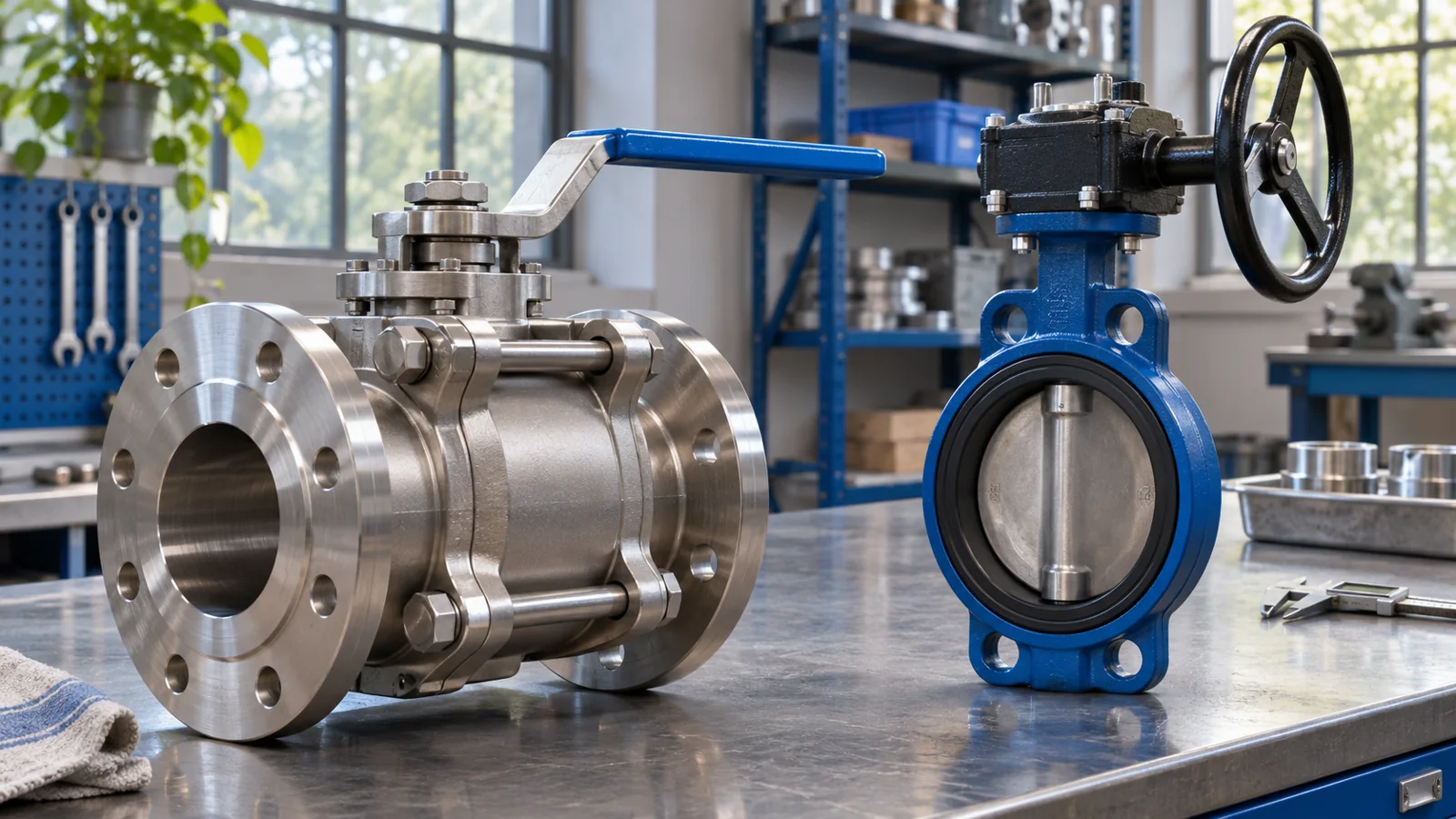
Una válvula de bola de paso total es un punto de partida útil cuando una tubería necesita un paso de flujo libre o debe permitir el paso de un rascador. Una válvula de mariposa puede ser adecuada para servicios de aislamiento de gran diámetro con límites más estrictos de peso o longitud de instalación. Compare el diámetro interior real o la holgura del disco, la fuga por asiento y el par de accionamiento en las condiciones especificadas.
La distinción resulta menos evidente al comparar diseños especializados. Una válvula de mariposa de alto rendimiento puede proporcionar un cierre hermético, mientras que una válvula de bola caracterizada puede regular el caudal. Por tanto, elegir entre ambas exige más que comparar el tamaño nominal, la clase de presión y una lista general de ventajas.
Cómo difieren las válvulas de bola y de mariposa en su funcionamiento
Una válvula de bola regula el caudal girando un elemento de cierre esférico con un paso a través de él. En la posición totalmente abierta, este paso queda alineado con la tubería. Un diseño de paso total puede ofrecer una abertura de flujo comparable a la de la tubería de conexión, mientras que un diseño de paso reducido tiene un paso menor.
Una válvula de mariposa gira un disco montado sobre un eje a través de la trayectoria del flujo. Cuando está totalmente abierta, el disco queda aproximadamente paralelo al flujo, pero el disco y el eje permanecen dentro del paso. Su forma y posición afectan la distribución de velocidades y la recuperación de presión a través de la válvula.
Esta diferencia va más allá del aspecto de las dos válvulas. El paso interno de la válvula de bola determina su abertura de flujo efectiva, mientras que la geometría del disco de la válvula de mariposa afecta tanto al área de flujo disponible como a las fuerzas del fluido que actúan sobre el disco. En consecuencia, dos válvulas con la misma designación DN o NPS pueden tener pérdidas de presión y pares de accionamiento diferentes.
Para un ingeniero que selecciona una válvula, estas distinciones estructurales son el punto de partida, no una clasificación de rendimiento por familia de válvulas.

Capacidad de flujo, caída de presión y requisitos de paso total
Por qué importan el diámetro interior real y el coeficiente de caudal
Una válvula de bola de paso total, completamente abierta y correctamente seleccionada, generalmente ofrece un paso menos obstruido que una válvula de mariposa convencional. Esto puede ser valioso cuando debe minimizarse la pérdida de presión. Sin embargo, una válvula de bola de paso reducido puede generar una restricción más significativa, y algunas válvulas de mariposa están diseñadas para una alta capacidad de caudal.
Por lo tanto, la comparación relevante es entre los coeficientes de caudal reales de las configuraciones de válvula propuestas, y no simplemente entre una válvula de bola y una válvula de mariposa del mismo tamaño nominal.
Para servicio de líquidos, Kv expresa la capacidad de caudal en condiciones de referencia definidas. Un Kv más alto significa que la válvula puede pasar más caudal con la misma presión diferencial, siempre que la comparación utilice condiciones coherentes. En una instalación real, las propiedades del fluido, las tuberías adyacentes y la presión diferencial disponible también influyen en el resultado.
Ejemplo hipotético — Línea de aislamiento de agua
Considere una tubería de agua que opera a 100 m³/h. Asigne a las dos válvulas candidatas completamente abiertas valores hipotéticos de Kv de 200 y 120, respectivamente. Para esta ilustración simplificada, tome la densidad relativa del agua como 1 y suponga que los coeficientes son aplicables en las condiciones de caudal indicadas.
La relación aproximada para el caudal de líquido es:
ΔP (bar) ≈ SG × (Q/Kv)²
donde Q está en m³/h y SG es la densidad relativa del líquido.
Para el Candidato A, con Kv = 200:
ΔP = (100/200)² = 0.250 bar (25.0 kPa).
Para el Candidato B, con Kv = 120:
ΔP = (100/120)² ≈ 0.694 bar (69.4 kPa).
Suppose the project allows a maximum valve pressure drop of 0.40 bar at this flow. Candidate A satisfies that hypothetical limit, while Candidate B does not.
Este cálculo no determina qué familia de válvulas es mejor. El Candidato A podría ser una válvula de bola o una válvula de mariposa. El ejemplo demuestra por qué el coeficiente de caudal real modifica la decisión de ingeniería incluso cuando ambos productos tienen el mismo tamaño nominal de conexión.
Estos son coeficientes supuestos, no valores de desempeño medidos ni certificados. El cálculo simplificado también excluye efectos adicionales de tubería y limitaciones de caudal que pueden requerir un análisis de dimensionamiento más completo.
Cuando el paso de raspadores cambia la decisión
La caída de presión no es la única razón para exigir un paso de flujo libre. En una tubería diseñada para el paso de raspadores, inspección o limpieza, los dispositivos deben atravesar la válvula instalada sin encontrar una obstrucción interna incompatible.
Una válvula de bola de paso total adecuada puede ser candidata para este servicio, siempre que la geometría de su paso interior y el raspador seleccionado sean compatibles. Una válvula de mariposa convencional deja su disco y su eje en el paso de flujo incluso cuando está totalmente abierta, lo que la hace inadecuada para el paso de raspadores sin obstrucción convencional.
Las válvulas de bola de paso reducido pueden presentar una restricción similar. Incluso un producto descrito como de paso total no debe aceptarse automáticamente como apto para el paso de raspadores sin verificar su paso mínimo real, su geometría interna y los requisitos de paso de raspadores.
This creates a clear selection boundary: if unobstructed pig passage is mandatory, establish pigging compatibility before comparing weight, price, or ordinary flow capacity.
For a conventional water or process isolation line without pigging requirements, the comparison returns to the actual hydraulic performance and other operating constraints.
Shutoff Performance Depends on the Seat and Service Conditions
A common assumption is that ball valves provide better sealing than butterfly valves. This is too broad to be a useful engineering rule.
A ball valve closes by rotating its solid ball into a position where the flow passage no longer connects the upstream and downstream ports. Its seat arrangement provides the sealing interface. The sealing mechanism depends on whether the ball is floating or mechanically supported, the seat design, and the forces acting across the valve.
A butterfly valve closes by rotating its disc into contact with the seat or sealing system. In a resilient-seated design, deformation and contact between the disc and the elastomeric seat can produce a tight seal. Offset butterfly designs use different contact geometry, which changes how the sealing surfaces engage and disengage.
These differences influence friction, wear, and sealing behavior, but neither valve family has an exclusive claim to tight shutoff. Manufacturers offer particular butterfly valve series with documented bidirectional tight-shutoff performance, just as ball valves are available with different leakage requirements and seat constructions.
The operating conditions determine whether that performance is applicable.
Soft seats can provide effective sealing under suitable conditions, but their materials must tolerate the operating temperature, fluid chemistry, pressure differential, and expected cycling. A metal-seated configuration may be selected where an elastomer or polymer is unsuitable, but metal seating does not automatically mean better shutoff or greater resistance to every abrasive medium.
Solids can further complicate the comparison. Particles trapped at a ball-seat interface or along a butterfly disc sealing edge may interfere with closure or accelerate wear. The risk depends on particle characteristics, concentration, valve geometry, and how the valve is operated. Specialized designs may perform differently from standard isolation valves.
For a genuine comparison, both proposed valves must be assessed against the same shutoff duty. A buyer should establish the maximum required closing differential pressure, the acceptable seat leakage, the test direction, and the governing acceptance conditions.
A shell pressure test is not evidence of seat tightness, and a seat leakage test is not a fugitive-emissions test. Standards such as API 598 and ISO 5208 address relevant testing activities, but the applicable edition, test conditions, and acceptance criteria must be identified in the project specification.
One additional ball-valve consideration can arise in liquid service: certain closed ball-valve cavities may trap liquid. If that liquid can subsequently heat up, thermal expansion may require an appropriate cavity-pressure management arrangement. This is a configuration-specific issue rather than a reason to exclude ball valves generally.
The selection question is not whether one type seals better in principle. It is whether the specified construction can meet the required shutoff conditions throughout the intended service.
On-Off Isolation Versus Modulating Control
Ball valves and butterfly valves are frequently used for on-off isolation, but some configurations are also designed for modulating control. The intended duty needs to be established before comparing their control behavior.
An ordinary full-port isolation ball valve is principally selected to open or close the flow passage. Holding it partly open can create localized high-velocity flow and expose particular seating surfaces to conditions for which the valve may not have been designed.
A characterized or segmented ball valve is different. By shaping the ball opening—such as a V-notch—the designer can produce a more useful relationship between valve travel and flow capacity. Certain segmented ball valves are specifically intended for process control, including selected viscous or solids-bearing services.
Butterfly valves can also regulate flow. Their disc position changes the effective flow passage, and high-performance or characterized butterfly designs may provide useful control over a defined operating range. However, a conventional isolation butterfly valve should not be assumed to offer stable, accurate modulation merely because its disc can stop at intermediate angles.
The distinction becomes clearer when considering inherent versus installed flow characteristics.
An inherent flow characteristic describes how a valve's flow capacity changes with travel under a constant pressure differential. Once installed, the differential pressure across the valve may change as flow changes because the piping system also consumes pressure.
For example, as flow increases, frictional losses in the connected pipeline generally increase. This can reduce the pressure differential available across the control valve and alter the relationship between valve position and actual flow.
A valve with a suitable inherent characteristic can therefore behave differently after installation. The effect becomes important when the process load changes considerably or when stable control is required over a broad flow range.
For modulating service, the engineer should evaluate minimum, normal, and maximum flow conditions together with the corresponding valve differential pressures. The proposed valve's characteristic, operating travel range, actuator response, and risks such as excessive velocity, cavitation, or unstable control must then be considered.
The practical distinction is straightforward: for simple isolation, compare shutoff and fully open performance; for continuous modulation, compare the actual control configurations and their installed behavior.
Neither an ordinary ball valve nor a conventional butterfly valve should be treated as a precision control valve without evidence that the selected design is suitable for the intended duty.
Installation, Actuation, and Maintenance Constraints
Hydraulic and sealing performance are not enough if the valve cannot be installed or operated properly.
Butterfly disc clearance and pipe interfaces
A butterfly valve may offer a relatively short face-to-face dimension, which can be attractive when installation space is limited. Yet its rotating disc may extend beyond the body into the connecting pipe when open.
That creates a potential interference point with the pipe bore, flange arrangement, or nearby components. A butterfly valve can have nominally compatible flange connections but still encounter mechanical interference if the pipe's actual inside diameter is too small for the disc's sweep.
Bray's published 4-Cx double-offset butterfly valve installation manual provides a concrete example: the manufacturer specifies minimum pipe inside diameters to accommodate the open disc. Those dimensions belong to that particular product documentation; they are not universal butterfly-valve clearance requirements.
Before selecting a butterfly valve, the engineer should compare the actual pipe bore, valve disc envelope, flange arrangement, and installation drawing. Wafer, lug, and flanged constructions also involve different bolting and maintenance considerations.
In particular, a lug-type body does not by itself establish that a valve is approved for dead-end service or for retaining pressure when the downstream pipework is removed. That capability requires the exact product's documented pressure, direction, and installation limitations.
A ball valve avoids butterfly-disc intrusion into adjacent piping, but it may require more body length or a different actuator and maintenance envelope. These dimensions also need to be compared against the available space.
Operating torque is configuration-dependent
Both valve families use rotary operators, but this does not establish comparable actuator sizes.
Ball-valve torque is affected by seat contact, operating pressure differential, bearing or stem friction, and the valve's mechanical arrangement. The torque needed to initiate movement can differ from the torque required during travel or final seating.
Butterfly valves have their own seat-related torque requirements, while fluid flow around the disc can generate substantial dynamic torque. The magnitude and direction of these forces can change with disc angle, flow direction, and operating conditions.
A larger nominal valve does not therefore translate into one universal torque value, nor does a butterfly valve automatically need a smaller actuator than a comparable ball valve.
For automated duty, the actuator should be selected using the applicable valve torque data across the intended operating conditions, with the required operating time, cycling frequency, supply conditions, and fail action taken into account.
Maintenance access may shift the decision again. A short-body butterfly valve can fit within a restricted pipe run, but seat replacement or removal arrangements depend on its construction and the surrounding piping. A ball valve may offer another maintenance approach, with access requirements determined by whether the valve is one-piece, split-body, top-entry, or another design.
These are not merely installation details. They can determine whether a technically acceptable valve remains practical over its intended service life.
Which Valve Should You Specify?
The appropriate choice follows from the service requirement and the actual construction offered, not from a general rule that one valve type is more reliable, economical, or efficient.
| Application or constraint | More suitable starting point | What can change the choice |
|---|---|---|
| Unobstructed pipeline pigging | A verified piggable, full-opening ball valve | Actual through-bore geometry and pig compatibility; a standard full-port label alone is insufficient |
| Isolation with stringent allowable pressure loss | A full-bore ball valve may be attractive | A high-capacity butterfly valve or reduced-port ball valve can change the hydraulic comparison |
| Large-diameter isolation with limited installation length | A butterfly valve is often worth evaluating | Disc clearance, required shutoff performance, pressure-temperature rating, actuator envelope, and total installed arrangement |
| Tight shutoff under defined operating conditions | Either valve family | Exact seat construction, service conditions, closure differential pressure, and leakage acceptance |
| Continuous modulating control | A suitable characterized ball or control-oriented butterfly valve | Installed flow characteristic, control range, process load changes, and dynamic operating limits |
| Solids-bearing or erosive media | Application-specific construction | Particle characteristics, seat exposure, flow geometry, operating position, and documented material suitability |
En pantallas más pequeñas, desplace la tabla horizontalmente para leer todas las columnas.
Cost should be assessed after the technical candidates have been defined. A large butterfly valve may offer advantages in body size, weight, and installation arrangement, but specialized seats, materials, actuators, or maintenance requirements can change the overall economics. The lowest initial valve price does not necessarily represent the lowest installed or operating cost.
When preparing a specification, it is useful to compare the candidate ball valve y butterfly valve against one common set of requirements: service medium, design and operating pressure-temperature conditions, flow duty, maximum closing differential pressure, allowable leakage, end connections, available space, and actuation requirements.
Product documentation should then establish the details that determine acceptance. Actual bore and Cv/Kv data support the hydraulic comparison; general arrangement drawings establish geometric compatibility; seat and pressure-rating documentation support shutoff and service suitability; and actuator data show whether the intended operating duty can be met.
Where standards are specified, distinguish the purpose of each reference. API 608 and API 609 address relevant ball and butterfly valve product requirements; API 598 and ISO 5208 address applicable inspection and pressure-testing requirements; ASME B16.34 addresses relevant valve design and pressure-temperature rating requirements. The project must establish which editions and requirements apply to the proposed products.
For a pipeline that requires pigging or a clear full-bore passage, begin with a suitably designed ball valve. For large-diameter isolation where compact installation is a priority, evaluate a butterfly valve against the actual sealing and interface conditions. Where both can satisfy the duty, compare the documented hydraulic, mechanical, operational, and maintenance requirements before choosing.
For a project-specific comparison, provide the operating conditions and the relevant piping or valve drawings with your inquiry. These allow the proposed configurations to be assessed on the same technical basis rather than by valve type alone.
On a retrofit, use the existing flange and adjacent pipe drawings to check the offered valve. Verify clear passage for pigging where required, and check butterfly-disc travel and clearance where a butterfly valve is proposed. Compare shutoff performance under the same differential pressure and test basis.