
Categoría de producto industrial
Válvulas de pinza industriales para servicio con lodos y sólidos
Una válvula de pinza detiene el flujo comprimiendo un manguito flexible en lugar de desplazar un disco rígido a través de la corriente. Esto puede hacer que merezca la pena evaluarla para lodos abrasivos, fangos o sólidos a granel. La decisión comienza por el medio y el manguito, después por el rango de presión real, el servicio de cierre o estrangulamiento requerido y el mecanismo de cierre.
Comience aquí: una válvula de pinza es una candidata cuando un paso de flujo flexible y sin obstrucciones resuelve un problema de manejo de sólidos y el manguito puede soportar el servicio químico, térmico y mecánico. Si no se puede establecer cualquiera de las dos condiciones, compare otro tipo de válvula antes de especificarla.
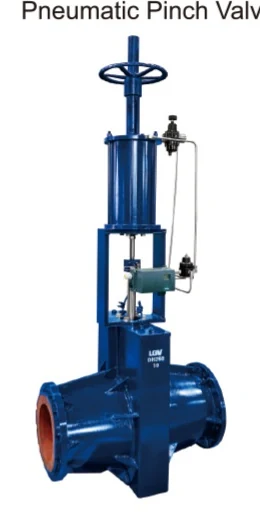
Pinza, guillotina o macho: ¿cuál se adapta al servicio?
Utilice la acción de cierre requerida —no solo el material bombeado— para acotar la familia de válvulas:
- Válvula de pinza: un manguito flexible forma el cierre y el paso de flujo. Merece evaluarse cuando las partículas pueden alojarse en asientos rígidos, siempre que el manguito y la actuación puedan soportar el servicio.
- Válvula de guillotina: una compuerta deslizante aísla la línea. Compare la disposición del asiento, la acumulación de sólidos, el diferencial de presión y el mantenimiento cuando el cierre con lodos es prioritario.
- Válvula de macho: un cierre rígido giratorio es un diseño de aislamiento diferente. Revise el medio, el par, la disposición de sellado y las necesidades de limpieza en lugar de suponer que es intercambiable con una válvula de manguito.
If prolonged partial opening is required, ask for a control-duty evaluation: a sleeve selected for on/off isolation should not automatically be specified for abrasive throttling.
The main selection risks
Four failure modes that change a pinch valve decision
The sleeve sees the process medium and repeated deformation. A suitable valve is defined by what can damage it or prevent the required closure—not by a generic slurry label.
- Swelling or hardening — check process and cleaning chemicals, concentration and temperature against the sleeve compound.
- Abrasive cutting — assess particle size, sharpness, solids loading, velocity and continuous throttling exposure.
- Incomplete reopening or collapse — disclose vacuum, long closed periods and reopening requirements.
- Inadequate closure — compare line pressure and transients with the actual available actuation/control pressure.
Closure and actuation
Specify how the sleeve will be pinched—and released
Two valves called “pneumatic pinch valves” may close in different ways. In a direct-air design, control air compresses the sleeve; in a mechanical design, pinch bars or another closing mechanism deform it, potentially driven by an air cylinder. Do not infer the working mechanism or loss-of-air position from a catalog photo.
Direct-air compression
Control pressure acts on the sleeve. Check the permitted process-pressure range, maximum control pressure, vacuum duty and the control-air pressure available at the installed valve. The required control-pressure margin is design-specific, not a universal fixed increment.
Mechanical sleeve compression
A handwheel, cylinder or another drive moves a mechanical closing element against the sleeve. For infrequent local isolation, manual operation may be practical; frequent remote cycling calls for a suitable powered mechanism and documented closing force and stroke.
Controls and loss-of-power action
For automatic operation, specify on/off or modulating duty, available supply pressure, valve/solenoid signals and the required position if air or power fails. “Pneumatic” alone does not establish fail-open, fail-closed or fail-in-place behavior.
Quote-ready process data
What information determines sleeve and valve configuration?
Provide the operating range, not only a single design-point value. The supplier must assess the sleeve compound and construction together with the closure method, connection and maintenance requirements.
| Área de decisión | Datos del comprador | Consecuencia en la selección |
|---|---|---|
| Medium and temperature | Full chemical composition, concentration, pH where relevant, minimum/normal/maximum temperature and cleaning fluids | Separates chemical resistance from abrasion resistance; both must suit the selected sleeve. |
| Solids and viscosity | Solids fraction; maximum and typical particle size, shape and hardness; viscosity or slurry consistency | Helps assess cutting, settling, blockage and the risk from sustained partial opening. |
| Pressure and vacuum | Normal and maximum upstream/downstream pressure, pressure at closing, surges and any suction/vacuum conditions | Separately defines pressure containment, closing differential and sleeve-collapse concerns. |
| Servicio de operación | Isolation or throttling, normal position, cycling frequency, time held closed and required response | Changes sleeve fatigue exposure, selection of pinch mechanism and control duty. |
| Actuation and fail action | Air pressure available at the valve, air quality, electrical/control signal and required position on supply failure | Determines whether the proposed closing arrangement can meet the real operating case. |
| Conexión de línea | Nominal line size, actual pipe bore, flange standard/drilling, face-to-face envelope and installation orientation | Prevents an otherwise suitable valve from being incompatible with the mating pipework. |
| Maintenance and documents | Access for sleeve removal, duty criticality, drawings, required inspection/testing and material records | Defines serviceability and what must be supplied or confirmed before approval. |
Process-specific choices
Choose the duty, not just the industry label
Abrasive slurry, sludge and pneumatically conveyed powder can all lead an engineer to consider pinch valves, but each exposes the sleeve and drive to a different limiting condition.
Abrasive mineral slurry
A full-opening sleeve can help avoid fixed obstructions in a solids stream. For high solids loading and frequent throttling, ask for a control-duty sleeve assessment and pressure-drop details; wear at the restriction may govern selection.
Wastewater sludge and fibrous solids
Review fibers, sediment, intermittent operation and cleanout access. Where the valve sits on a suction line, assess whether the sleeve needs a vacuum-suitable design rather than assuming a standard sleeve will stay open.
Powder and pneumatic conveying
Include carrier gas, conveying pressure or vacuum, powder abrasiveness, switching frequency and static/electrical-area requirements. Do not assume a general industrial pinch valve carries hazardous-area approval.
Service planning
Plan sleeve inspection and replacement before ordering
The sleeve is a service-dependent wear component. Replacement intervals cannot be inferred from the valve family alone; they depend on the actual media, pressure, cycles, temperature and operating method. Include service access and the applicable sleeve identification in the order review.
Inspect the working sleeve
Ask how damage such as cracks, permanent deformation or exposed reinforcement is identified for the proposed design, and what removal clearance and spare sleeve information are required.
Assess air-circuit exposure
In some direct-air designs, a ruptured sleeve can allow process medium into the control-air line and downstream components. Review the proposed design and the need for isolation or protection, especially with hazardous media.
Design a safe changeout
Verify that the installation allows the process and actuator to be safely isolated, depressurized and accessed for sleeve replacement. Request the specific service instructions; a generic sleeve-replacement method is not enough.
Continue your evaluation
Compare product families or prepare the specification
For a solids-bearing isolation duty, compare knife gate valves where a sliding closure may fit, or plug valves where a rigid rotary closure is being considered. The links below lead to the broader product range, application context and company resources.
Browse the complete valve range
Check other isolation and control families when sleeve chemistry, pressure, vacuum or throttling duty rules out a pinch valve.
Explore operating environments
Use process and industry pages for context, then specify the actual medium, pressure and operating cycle.
Review manufacturing information
Understand the published company-level processes; request configuration-specific drawings or records with the inquiry.
Read technical comparisons
Keep general technical reading separate from the equipment and documentation needed for an order.
Application-based quotation
Request a pinch valve configuration for your duty
Send what you know about the medium, duty and piping. Indicate whether you require shutoff or flow control and the required loss-of-air action. We can review a proposed configuration against those inputs; unknown values should be marked for clarification, not guessed.
- Line size, end connections and any face-to-face constraint
- Medium chemistry, concentration and cleaning fluids
- Solids loading, particle characteristics and viscosity
- Minimum, normal and maximum temperature
- Upstream/downstream pressure, surges and vacuum duty
- On/off or control duty, cycling and maximum closed dwell
- Available control air, electrical signal and required fail action
- Required sleeve information, drawings, tests and project documents