
Válvulas de retención industriales · Selección de clapeta oscilante
Válvulas de retención de clapeta para tuberías industriales
Una válvula de retención de clapeta utiliza un disco articulado que gira para abrirse con el flujo directo y vuelve hacia su asiento cuando el flujo disminuye o se invierte. Puede ser adecuada para servicio de no retorno cuando el disco permanece estable en todo el rango de operación y la respuesta de cierre se ajusta al sistema. En descarga de bombas u otros transitorios rápidos, evalúe la aceleración del flujo inverso antes de asumir que un diseño de clapeta es adecuado.
Evidencia del catálogo: El catálogo del proveedor incluye una válvula de retención H44W según norma GB (página 82 del PDF físico, página impresa 153). Se trata de una posible referencia de tipo clapeta, no de la confirmación de que el artículo VALMORA exacto ofrecido tenga un disco de clapeta articulado ni de que esté listo para pedido. Solicite el plano de sección, la ficha técnica, las instrucciones de instalación y los datos verificados de tamaño, clase, materiales y límites de presión-temperatura del artículo ofrecido antes de la selección.
Cómo funciona un disco oscilante
1 · Flujo directo separa el disco articulado del asiento.
2 · El flujo se desacelera y el disco comienza a regresar. Su respuesta depende de la geometría, la gravedad, cualquier asistencia de cierre y la dinámica de fluidos.
3 · Diferencial inverso carga el disco contra el asiento. La fuga real y el tiempo de cierre dependen del producto y del servicio.
Explicación del mecanismo: no es un plano de producto VALMORA ni una curva de rendimiento de cierre verificada.
Selección de un vistazo
¿Cuándo es la válvula de retención de disco oscilante la opción adecuada?
Una válvula de retención de disco oscilante es una candidata cuando el flujo normal puede mantener abierto su disco articulado, la orientación prevista está respaldada por el diseño seleccionado y su comportamiento de cierre es aceptable durante la parada. Son comprobaciones independientes: una válvula que encaja en las bridas de la tubería puede aun así vibrar o cerrar demasiado tarde para el proceso.
Considere un diseño oscilante
Servicio unidireccional relativamente estable con caudal mínimo adecuado, pérdida de presión manejable y acceso al bonete o a la bisagra para mantenimiento. Confirme los datos reales de apertura y pérdida de la válvula seleccionada.
Comparar un diseño de recorrido más corto
Cuando una bomba puede detenerse abruptamente o la aceleración del flujo inverso es alta, compare válvulas de retención silenciosas asistidas por resorte o de flujo axial y revise el transitorio hidráulico. Un cierre más rápido puede reducir la velocidad inversa, pero no garantiza la ausencia total de golpe de ariete.
No seleccionar solo por el nombre
Caudal muy bajo o fluctuante, tuberías verticales/descendentes, ciclos frecuentes o ausencia de un plano confirmado del disco oscilante son motivos para retener la configuración para revisión de ingeniería. El tamaño y la clase nominal por sí solos no resuelven estas condiciones.
Selección de proyecto · Datos requeridos
Ajustar la respuesta del disco a todo el ciclo de operación
Para las válvulas de retención, el caso más difícil no es necesariamente el caudal máximo. El caudal mínimo en sentido directo pone a prueba la estabilidad del disco; una parada rápida de la bomba o una inversión de presión ponen a prueba el cierre. Proporcione ambos casos y solicite la evidencia de pérdida de presión y de cierre de la válvula ofrecida cuando el riesgo de transitorio sea relevante.
| Pregunta de selección | Datos de entrada del proyecto | Qué cambia la elección |
|---|---|---|
| Estabilidad del caudal | Caudal mínimo, normal y máximo; densidad del fluido; tamaño de tubería | Check that the disc opens stably at minimum flow and that pressure loss is acceptable at duty flow; request product-specific curves. |
| Stop or reversal | Pump coastdown/trip, differential head, cycling rate, existing surge history | If reversal can accelerate quickly, assess the transient and compare shorter-travel or assisted-closure designs before selecting swing. |
| Installation direction | Horizontal or vertical piping; up/down flow; hinge/bonnet clearance | Specify hinge and bonnet orientation per the manufacturer. Vertical upward may be allowed for some designs; never assume vertical downward is acceptable. |
| Service compatibility | Medium, solids, operating/design pressure and temperature, seat leakage requirement | Confirm materials, seat and body ratings at temperature, fluid compatibility and test/leakage basis for the offered model. |
| Pipeline interfaces | End connection, face-to-face, upstream disturbances, lifting and cover access | Review the drawing and installation instructions; allow actual maintenance clearance and model-specific straight-run requirements. |
Where service conditions matter
Three duty cases that lead to different check-valve choices
A swing check may be appropriate in more than one industry, but pump behavior, flow stability and orientation determine whether it remains the right non-return mechanism. No application below is a claimed VALMORA installation reference.
Steady process non-return duty
For relatively stable forward flow, first check that the hinged disc stays sufficiently open at minimum duty and that the valve’s seat, materials and pressure drop suit the medium. If the system runs at very low flow for long periods, review chatter before specifying swing.
Pump discharge with fast shutdown
A pump trip can establish reverse velocity before a long-travel swing disc seats. Obtain the pump coastdown and system head profile; compare closing behavior with silent, axial or other quick-acting designs if surge is important. Do not assume any type is slam-free without a system check.
Large pipe runs or limited access
Review bonnet removal, hinge maintenance, available lifting space and flow disturbances near the valve. Inaccessible internals or insufficient straight run can change the practical choice even when nominal size and pressure class match.
Disc travel · Reverse-flow acceleration
Why a swing check may chatter or slam
At low forward velocity, the disc can move away from its stable open position and repeatedly contact internal stops or the seat. During a fast shutdown, reverse flow may develop while the disc is still traveling, increasing the severity of closure. These are system-and-valve interactions—not properties that can be judged from a catalog photo.
- Low-flow or fluctuating duty: request the disc-stability and minimum-flow basis.
- Pump stops or check-valve noise: review the transient, not only the nominal rating.
- External levers, weights or springs: use only if the offered configuration and installation documents support them.
- Do not treat “silent,” “quick-closing” or “non-slam” as a system-wide zero-surge guarantee.
Installation and specification boundaries
Installation details can change the valve choice
The manufacturer’s model-specific installation instructions govern permitted flow direction and hinge orientation. General swing-check guidance is useful for screening, but it is not approval for a particular VALMORA configuration.
Horizontal line
Conventional gravity-assisted swing checks generally require a horizontal hinge axis with the bonnet above the flow path. Incorrect rotation can leave the disc hanging open or impair closing. Confirm the offered valve drawing before installation.
Vertical line
Some swing checks can operate in an upward-flow vertical line if their design permits it; downward-flow installation must not be presumed acceptable. Check the actual valve arrangement and any closing-assist requirements.
Nearby pump, elbow and service access
Upstream turbulence and pulsation may encourage disc cycling. Follow the manufacturer’s specified straight-run and maintenance clearances; values from another manufacturer’s manual are not VALMORA installation limits.
Original catalog · H44W lead and construction comparison
Catalog leads: H44W candidate and lift-check alternative
GB Standard H44W Check Valve — potential swing-type catalog lead; verify construction. The catalog identifies this item on physical page 82 (printed page 153). Its separate WP308 catalog record documents the listed product identity, but neither that label nor a common H44W designation verifies the offered item’s hinged-disc mechanism, specifications or availability. Obtain the exact sectional drawing and model-specific datasheet before specifying it as a swing check valve.
Separate lift-check comparison: The retained source image below is labeled Válvula de retención de elevación vertical GB on the same physical page (printed page 154). A guided lift disc moves along its axis; a swing check disc rotates about a hinge. This image is only a comparison, not evidence of the H44W configuration or a VALMORA swing model.
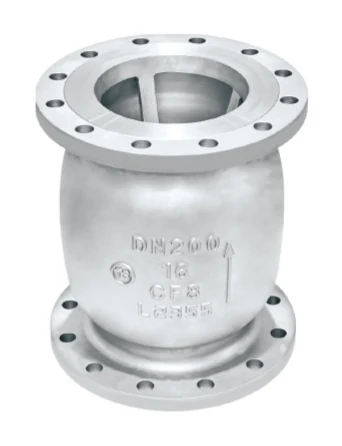
The catalog labels this product as a Válvula de retención de elevación vertical GB. Confirm its permitted installation, lifting mechanism and operating conditions from its own model drawing. A separately labeled Válvula de retención ASME is also listed on the same catalog spread; that generic label does not establish swing construction.
Compare nearby check-valve constructions
Swing, lift, silent and quick-closing are not interchangeable
Comience con all check valves if the duty is not yet defined. For the catalog-listed candidate, use the GB Standard H44W product record to identify the item, then request confirmation of the offered disc construction rather than assuming swing service. For a wider valve portfolio, industry contexts o technical resources, follow those separate routes. Select the check-valve mechanism against flow and closure conditions.
Check Valves — parent family
Choose the right non-return family before narrowing to a hinge, lift or spring-assisted closure.
Válvulas de retención de elevación
Compare guided lifting motion rather than a swinging disc, especially where the lifting arrangement changes orientation or pressure loss.
Válvulas de retención silenciosas
Consider spring-assisted, shorter-travel closure when the reverse-flow event is rapid; verify the specific product and system response.
Válvulas de retención de cierre rápido
Review a separately documented quick-closing route where trip behavior and controlled closure are key project variables.
Practical buyer questions
Swing Check Valve Questions
These answers describe swing-check selection principles. A quoted VALMORA model still requires its own drawing, datasheet and confirmed service limits.
Can a swing check valve be installed vertically?
Some designs permit vertical upward flow when the hinge arrangement and closing forces are suitable. Do not assume vertical downward flow is allowed; obtain the exact model installation drawing and flow-direction requirements.
What happens when a swing check operates at low flow?
At insufficient or fluctuating forward velocity, a hinged disc may not stay fully open and can flutter or chatter. Provide minimum continuous flow and ask for the offered valve’s disc-stability and pressure-loss guidance.
Will a swing check valve prevent water hammer after a pump trip?
Not necessarily. If reverse flow develops before the disc closes, seating can produce a pressure surge. Review pump coastdown and system transients; compare silent, axial-flow or engineered quick-closing alternatives when needed.
What should accompany a swing check valve quotation?
Request a confirmed swing-disc construction or sectional drawing, size and end dimensions, pressure-temperature limits, body and seat materials, installation orientation, applicable inspection/testing basis, and any required order-specific certificates or records.
Request product confirmation
Send a swing check valve RFQ that can be evaluated
Share the operating envelope and describe the shutdown or reverse-flow event. Ask VALMORA to confirm a specific swing-disc construction and provide the corresponding drawing, rated service limits and installation instructions. If frequent trips, low flow or possible surge dominate the duty, request comparison with another check-valve mechanism before fixing the specification.
- Required duty: prevention of reverse flow and expected cycle frequency
- Flow: minimum, normal and maximum rates; pipeline size and direction
- Shutdown: pump trip/coastdown, reverse head and acceptable surge or leakage
- Service: medium, solids, design and operating pressure-temperature cases
- Configuration: end connections, piping orientation and access limits
- Offered proof: disc/hinge drawing, dimensions, seat and body data
- Documents: applicable standards, inspection/test basis and project records
- Unknowns: explicitly flag any value that needs engineering confirmation