
Catalog-listed power station globe valve
Válvula Globo Tipo T de Alta Temperatura e Alta Pressão com Autovedação
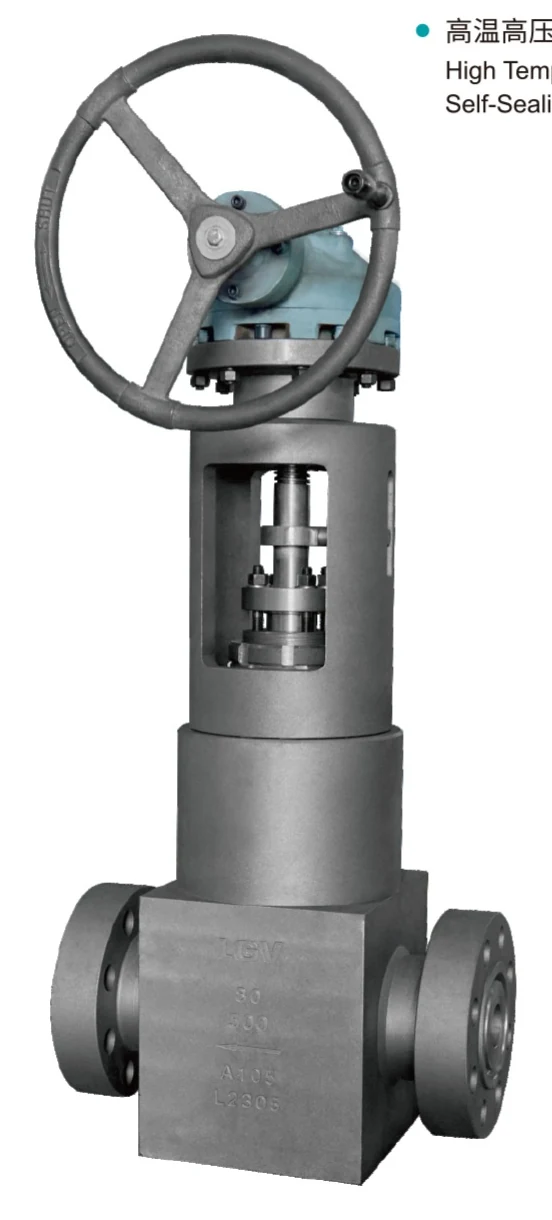
Este T-type globe valve is cataloged for high-temperature, high-pressure service with a self-sealing bonnet. The T-pattern describes the valve-body flow route; the pressure seal describes the body-to-bonnet joint, not the disc-to-seat shutoff. For a project quotation, first confirm that the required flow and allowable pressure loss suit a T-pattern valve, then specify the pressure-temperature envelope and shutoff duty.
- Catalog body pattern: T-type globe valve
- Bonnet designation: pressure self-sealing
- High-temperature / high-pressure: no numeric rating established by the catalog caption
Identidade do produto
T-pattern globe valve in the power-station catalog
The catalog identifies a T-type globe valve with pressure self-sealing construction. It is a distinct product entry, not an alternative photograph of the neighboring power-plant globe valve. The photographed unit has a tall handwheel and flanged-looking ends; its visible markings and appearance are não an approved material list, pressure-temperature rating or connection specification.
Família de produtos
Globe valve, T-pattern. A conventional T-pattern flow passage turns through the seat region and generally causes more pressure loss than a comparable Y-pattern. Actual loss depends on the offered trim, opening and service flow.
Série de catálogo
Power Station Valve. This is the catalog grouping. It does not by itself confirm suitability for a particular main-steam, feedwater or bypass line.
Fonte de evidência
Original valve catalog, physical PDF page 65 (printed page 119), second product from the left. This photographed product is separate from the blue valve immediately to its left.
Evidência do catálogo
Verified catalog identity and quotation data
The catalog caption establishes the product identity, T-type designation and pressure self-sealing description. It does não supply a model-specific NPS/DN range, pressure class, material grade, temperature limit or seat-leakage rating. Use the approved offered datasheet for those values.
| Campo | Evidência do catálogo | O que ela estabelece |
|---|---|---|
| Item do catálogo | Válvula Globo Tipo T de Alta Temperatura e Alta Pressão com Autovedação | Printed product caption |
| Valve family and body pattern | Globe valve; T-type | Printed product caption |
| Bonnet description | Vedação automática por pressão | Printed product caption; sealing details not specified |
| Descrição do serviço | Alta temperatura e alta pressão | Descriptive words only; no numeric limit supplied |
| Família do catálogo | Válvula para Usina Termelétrica | Título da seção do catálogo |
| Illustrated unit | Dark body; large handwheel; two visible flanged-looking ends | Photo observation; not a configuration guarantee |
| Local de origem | Physical PDF page 65 / printed page 119, second from left | Catalog page and picture mapping |
Not shown in the catalog caption: pressure-temperature rating, bore, wall thickness, trim and seat design, gasket grade, flow coefficient, applicable inspection standard, end-connection specification and guaranteed seat leakage. Request these on the technical offer.
Limite de evidência
Three different design questions: body, bonnet and seat
T-type concerns body/flow-path geometry and the likely pressure-loss trade-off against Y-pattern. Vedação automática por pressão concerns the joint between body and bonnet: in a typical pressure-seal design, line pressure increases the compressive load on the bonnet sealing ring. Seat shutoff is a separate disc-to-seat function and needs its own leakage criterion and test evidence. None of these terms independently establishes the other two.
O que o catálogo realmente identifica
- A separate T-type globe-valve listing in the Power Station Valve section
- Pressure self-sealing named in the catalog; internal joint details are not shown
- The dark valve at printed page 119, second from left, matches this listing
What the technical offer must establish
- Maximum and minimum operating/design pressures and temperatures, including transients
- Body, bonnet, trim, seat, packing and pressure-seal gasket materials
- Disc/seat arrangement, required shutoff class and seat-leakage test conditions
- Flow direction, flow capacity/pressure loss and allowable differential pressure
- NPS/DN, end connection, facing or weld details and GA dimensions
- Test/inspection scope, applicable code edition and offered documentation
Análise de engenharia
When to specify T-pattern rather than compare a Y-pattern
A T-pattern candidate is worth reviewing when isolation or a defined throttling duty is required e the piping system can accept its pressure loss. If continuous full-open flow or limited available differential pressure dominates the duty, request a comparison with a Y-pattern option before accepting the T-pattern. Neither choice is proven without offered flow data.
Start with flow and available pressure drop
Give normal, minimum and maximum flow plus upstream and downstream operating pressures. Ask for the proposed valve’s flow coefficient or pressure-drop calculation at the relevant opening. A T-pattern usually has a less direct flow passage than a Y-pattern, but a catalog name cannot quantify loss. If the predicted loss exceeds the system allowance, do not choose this valve solely because its pressure designation sounds suitable.
Check pressure rating at temperature
Identify the design pressure, maximum/minimum metal temperature and startup/shutdown transients. Require an offered pressure-temperature rating tied to the actual pressure-containing material and applicable code or specification. “High pressure” and “high temperature” in a name are not a Class, PN or permitted pressure at a stated temperature.
Specify bonnet seal and seat shutoff separately
Request the pressure-seal bonnet drawing or assembly details, gasket material and instructions for startup/pressure cycling. Independently state whether the valve must provide tight isolation or controlled throttling, then request the disc/seat material, leakage criterion and corresponding test evidence. A pressure-assisted bonnet seal is not proof of bubble-tight shutoff at the seat.
Confirm piping interface and operating force
The pictured example uses a handwheel and shows two flanged-looking ends, but the ordered connection, facing, dimensions and actuator must be specified. Confirm flow direction, installation space and the handwheel operating force or actuator sizing at the maximum differential pressure; a handwheel in the photo does not certify that the project configuration is manual.
Request offer-specific evidence
Compare the supplier’s approved datasheet, general arrangement and cross-section drawings, bill of materials, pressure-temperature table, leakage/pressure test plan and applicable standard editions with the purchase specification. Ask for a deviation list rather than treating an unlisted test, certificate or design feature as included.
Limite de aplicação
High-pressure service does not settle the body-pattern choice
The product is filed under power-station valves, but line duty still controls selection. A pressure-seal bonnet may suit high-pressure containment while the T-pattern’s passage can impose a greater hydraulic penalty than a Y-pattern. Evaluate the two effects separately before choosing a construction.
Continuous-flow duty
Where pressure loss affects pump head, steam delivery or energy consumption, request actual flow-capacity data for this T-pattern and a comparable Y-pattern candidate. If the available pressure-loss budget cannot accommodate the T-pattern, ask for the alternative rather than assuming the pressure-seal bonnet solves the restriction.
Intermittent isolation or throttling
For primarily closed/open isolation, prioritize required seat tightness, differential pressure and operating force. For frequent intermediate-position service, also evaluate trim geometry, erosion, noise and cavitation or flashing risks where applicable. The catalog image does not prove that this particular trim is rated for severe throttling.
Startup, flow direction and access
Pressure-assisted bonnet joints require an initial seal before full operating pressure develops; gasket design and assembly procedure matter during pressure cycling. Confirm the selected valve’s startup requirements, flow arrow, bonnet maintenance access and piping loads against its own installation/maintenance instructions—not an adjacent product manual.
Rotas de produtos relacionados
Compare neighboring globe-valve catalog entries
These linked entries have different catalog labels and photographs. Compare their own body layout, pressure rating and documents; do not substitute one neighbor’s image, inferred flow pattern or certified range for this T-type listing.
Válvula Globo de Alta Pressão com Autovedação ASME
ASME appears in that product name, not in this T-type caption. Ask which design-code edition and pressure-temperature rating the offered valve actually meets; do not infer compliance from the title.
Válvula Globo de Alta Pressão com Autovedação para Usina Termelétrica
A separate power-plant pressure-seal globe valve, pictured immediately to the left in the same catalog spread. Its blue photograph is not this T-type product image.
Válvula Globo de Alta Temperatura e Alta Pressão com Autovedação para Usina Termelétrica
Another high-temperature/high-pressure power-plant globe-valve listing. Compare its specific drawing and flow route rather than assuming the same T-pattern internals.
Perguntas do comprador
T-type pressure-seal globe valve: buyer questions
The body pattern, bonnet joint and seat shutoff answer different engineering questions.
Is a T-type globe valve the same as a Y-pattern valve?
No. In conventional designs, a T-pattern has a more tortuous passage around the seat, while a Y-pattern generally offers a straighter flow route. The resulting pressure loss must be compared using the offered valve and actual operating flow.
Does a pressure-seal bonnet guarantee tight shutoff?
No. The pressure seal is the body-to-bonnet joint. Shutoff occurs at the disc and seat, so the required seat-leakage acceptance criterion and test conditions must be stated separately.
What is this valve’s pressure-temperature rating?
The visible catalog caption gives no numeric Class/PN or temperature limit. Request a configuration-specific datasheet with the body material, applicable pressure-temperature rating and transients before selecting the valve.
What should accompany a quotation for this T-type valve?
Provide the service fluid, flow range, inlet/outlet pressures, temperature extremes, size, piping ends and isolation/throttling duty. Ask for GA/cross-section drawings, flow data where necessary, materials, seat-leakage tests, bonnet seal details and the applicable standard edition.
Consulta técnica
Request a quotation for the T-type pressure-seal globe valve
Reference this catalog item and tell us whether low pressure loss, tight isolation or throttling performance matters most. Submit the duty information below so the offered T-pattern configuration, documentation and any necessary Y-pattern alternative can be reviewed without assuming undocumented ratings.
- Service fluid, flow range and line function (isolation, throttling or bypass)
- NPS/DN, design/operating pressure, temperature range and allowable pressure drop
- Required end connection, body/trim materials, seat leakage and bonnet seal documentation
- Actuation, maximum differential pressure, flow direction and available installation space
- Quantity, GA/datasheet, test reports, governing standards and inspection/witness requirements