
Isolamento liga/desliga industrial
Válvula gaveta de aço fundido

Uma válvula gaveta de aço fundido é uma candidata para isolamento liga/desliga em tubulação quando a gaveta normalmente estiver totalmente aberta ou totalmente fechada. Não é o ponto de partida adequado para estrangulamento contínuo: uma gaveta parcialmente aberta pode sofrer vibração e erosão da sede.
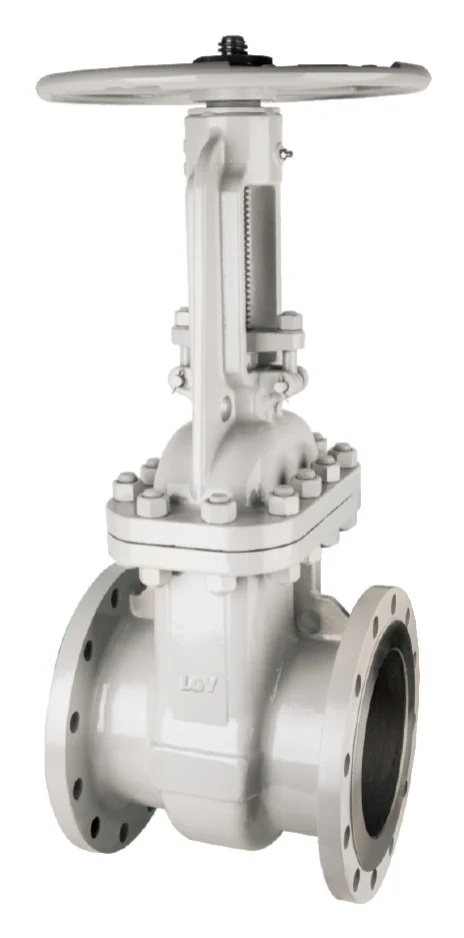
O catálogo de origem identifica a válvula azul, operada por volante, mostrada aqui Válvula gaveta de aço fundido. Suas extremidades flangeadas e junta de castelo parafusado são visíveis neste exemplo; o grau exato do corpo, o trim, a norma dimensional e a classificação de serviço devem constar nos documentos da válvula ofertada.
- Serviço: isolamento totalmente aberto / totalmente fechado, sujeito à especificação do processo
- Exemplo ilustrado: extremidades flangeadas e volante; sem faixa confirmada de tamanho ou pressão para todo o pedido
Evidência do catálogo
Válvula gaveta de aço fundido: o que especificar
O catálogo fornece um rótulo de produto e imagens, não uma folha de dados pronta para pedido. Use a amostra visível como referência e, em seguida, obtenha um desenho, lista de materiais e classificação de pressão-temperatura específicos para a configuração da válvula que você pretende comprar.
| Item de seleção | Evidência do catálogo / foto | O que a cotação deve estabelecer |
|---|---|---|
| Identidade do produto | “Válvula Gaveta de Aço Fundido” na Série de Válvulas Gaveta; unidade azul no catálogo PDF p. 75 (p. impressa 140). | Use este nome de página ao solicitar uma oferta correspondente. |
| Hardware ilustrado | Volante, conexões de extremidade flangeadas e junta corpo–castelo parafusada estão visíveis. | Confirme o castelo, a haste, o operador, o faceamento e a furação do flange oferecidos. |
| Marcações da peça fundida ilustradas | O exemplo azul mostra “DN400”, “16” e “WCB” na peça fundida. | São marcações em uma imagem, não um grau, rating ou faixa comercializável completa certificados. |
| Tamanho e rating | Nenhum quadro confirmado de DN/NPS ou PN/Class para toda a linha de produtos é fornecido nesta página dupla. | Solicite tamanho nominal, designação de rating e pressão admissível na temperatura de projeto. |
| Materiais e trim | “Aço fundido” é o descritor do catálogo; não há lista completa de materiais verificada. | Especifique o grau do corpo/castelo, cunha/gaveta, haste, faces de sede, gaxeta, junta e parafusos. |
| End dimensions & testing | The image is not a flange dimension drawing or pressure-test record. | Request face-to-face, end/facing drawings, shell and seat test standard, results and marking schedule. |
Image-marking distinction: a legible casting mark is not a material certificate or a pressure–temperature table. For engineering approval, match the final drawing, nameplate/marking, material records and test documents to one specified valve.
Limite de evidência
Is this the right valve for the duty?
Start with how the valve will operate and what passes through it. These two questions can rule out the wrong design before comparing material grades or nominal ratings.
Use it for isolation when…
- The intended duty is mostly fully open or fully closed, with a specified shutoff requirement.
- The fluid and its solids content are compatible with the proposed gate, seat faces and packing.
- The expected opening/closing differential pressure and operating frequency are within the selected assembly’s capability.
Reconsider the design when…
- Continuous flow control or frequent part-open positioning is required: use a valve designed and sized for throttling.
- Abrasive solids, deposits or crystallization could foul the seat or travel path: review a suitable severe-service isolation design.
- The specified operating differential pressure makes manual closing torque impractical: assess gearing or an engineered actuator.
- The pipeline cannot accommodate valve height, mechanical loads or maintenance access: check a different construction or location.
Configuration details
Build a quotation around the service conditions
A meaningful quote identifies one working valve assembly, not only “cast steel” and a nominal size. Give the process requirements below and ask VALMORA to return the matching configuration and supporting documents.
Pressure, temperature and shutoff
Provide design and operating pressures, maximum differential pressure during closure/opening, minimum and maximum temperatures, vacuum or surge cases, and required seat leakage performance. PN/Class is a rating designation, not a fixed allowable working pressure at every temperature. The selected body material, design standard and pressure–temperature table must agree for the complete duty.
Body, gate, seats and stem
Specify fluid composition, concentration, chlorides or other relevant corrosives, suspended solids, erosion potential and any cleaning fluid. Ask for the exact cast body/bonnet grade; gate or wedge construction; seat and hardfacing materials; stem, packing, gasket and bolting details. “Cast steel” does not automatically mean ASTM A216 WCB, nor does a body grade alone establish wetted-part compatibility.
Flanged interface and dimensions
The pictured sample has flanges, but the photograph does not identify their standard, pressure class, facing, drilling or gasket. Supply the mating pipe/flange specification, pipe bore, face-to-face requirement and preferred end connection. Require dimensioned drawings before fabrication; do not assume different flange standards or nominally similar drilling are interchangeable. If a weld end is requested, treat it as a separate configuration to confirm.
Operator, torque and travel
A handwheel appears in the source image. Confirm whether the order needs manual operation, gear assistance or engineered actuation, based on valve size, differential pressure, cycling frequency and safe operator access. Request required operating torque and full-open travel/height; any electrical or pneumatic utilities, controls and fail action belong in the actuator specification, not in the unverified base catalog identity.
Inspection, documents and markings
State the required design and test standards with editions, shell and seat test criteria, material certification/heat traceability, inspection and third-party witness points. Request the nameplate/marking schedule, approved general arrangement and end drawings, plus applicable packing, installation and maintenance instructions. Require records for the offered valve and order, not generic brochure statements.
Limite de aplicação
Check the piping and access before release
A valve can meet the process rating and still be wrong for the available installation. Review these constraints against the supplier drawing and installation instructions before approving the purchase.
Orientation and piping loads
For typical handwheel gate valves, installation in a horizontal run with the stem upright is commonly recommended. Do not assume this specific item may be installed sideways or inverted without written design approval. Support the adjacent pipework, account for thermal expansion and avoid using flange bolts to pull a misaligned system into place. Respect any actual flow-direction marking.
Operating clearance and service
Check the open-height envelope, handwheel reach, lifting access and space for bonnet, stem and packing maintenance. A rising-stem design may need substantial vertical clearance; the stem arrangement and full-open dimension of the offered valve must be shown on the drawing. Plan safe isolation, depressurization and drainage before service.
Deposits, corrosion and flushing
Check the medium’s chemistry across all operating and cleaning conditions, including stagnant periods, solids and deposits. Debris trapped at the seats can prevent shutoff; high-velocity flow through a partly opened gate can damage seating surfaces. Specify flushing/cleanliness expectations and ask how the proposed trim and seat construction address the actual fluid.
Evidência visual
Catalog photo and an adjacent GOST variant
Both images come from the same physical PDF page, but they are different catalog entries. The blue valve is labeled Válvula gaveta de aço fundido; the silver valve to its right is labeled GOST Cast Steel Gate Valve. The silver image is retained here only to prevent confusion when comparing the catalog—not as a second view, specification or supplied variant of this product.
Different purchase requirements
Other valve routes for different specifications
Utilize o Gate Valves category for the full family. The pages below own different catalog or material questions; a term on one page does not establish the materials, standards, accessories or ratings of another.
Additional original catalog routes: Válvula gaveta elétrica de grande diâmetro, Válvula gaveta elétrica ASME de grande diâmetro, e Válvula gaveta ASME de grande diâmetro. These are separate designs, not specifications for this item.
Válvula Gaveta ASME
An independently labeled ASME catalog identity. Choose this route when the project specifically cites an ASME-based valve specification; check its own offered standard and configuration instead of transferring them here.
Válvula Gaveta Elétrica
Use this separate record when motorized operation is part of the buyer requirement. The electric-drive description must not be applied to the handwheel example on this page.
Válvulas de aço forjado
Different material-form and product-family route. When a project specifically requires forged construction, check this series rather than treating a cast-steel label as interchangeable.
Perguntas do comprador
Questions before ordering
These points matter when translating a catalog photo into a purchase order.
Does “WCB” on the photograph guarantee WCB construction?
No. “WCB” is legible on the photographed blue casting, but the catalog spread does not establish that every offer under this name uses ASTM A216 Grade WCB. Request the exact body and bonnet material grade, a traceable material certificate and the corresponding marking schedule for the actual order.
Can this gate valve be held partly open to regulate flow?
Do not select it for continuous throttling on the basis of this catalog label. Conventional gate valves are intended primarily for fully open or fully closed service; partial opening can accelerate vibration and seat wear. Use a valve selected for flow regulation when throttling is a process requirement.
Do the visible “DN400” and “16” marks set the order rating?
No. Those characters are visible on one photographed valve and do not establish the complete DN/NPS range, a confirmed PN/Class designation, or the maximum working pressure at service temperature. The applicable pressure–temperature rating, end dimensions and nameplate must match the specific supplied valve.
Which documents should accompany the technical offer?
Request a configuration datasheet and general-arrangement drawing; pressure–temperature rating; complete body, gate, stem, seat and seal materials; applicable design and test standards; inspection/test records and witness plan where required; material certificates and traceability; nameplate/marking details; and installation/maintenance information. State which items are required before order placement or shipment.
Technical RFQ
Request the Cast Steel Gate Valve configuration
Send your line conditions or piping specification with the catalog reference. VALMORA can review the proposed valve configuration and identify the drawing, material, inspection and commercial details to confirm in a quotation.
- Service medium, composition, solids/corrosion risks and isolation duty
- Required DN/NPS, design and operating pressures, PN/Class and minimum/maximum temperatures
- Flange/end standard, facing, mating pipe dimensions, available height and preferred orientation
- Body/bonnet grade, gate and seat trim, packing and desired handwheel/gear/actuator
- Quantity, required delivery documents, tests, material records, marking and third-party witness points