
Válvula guilhotina pneumática
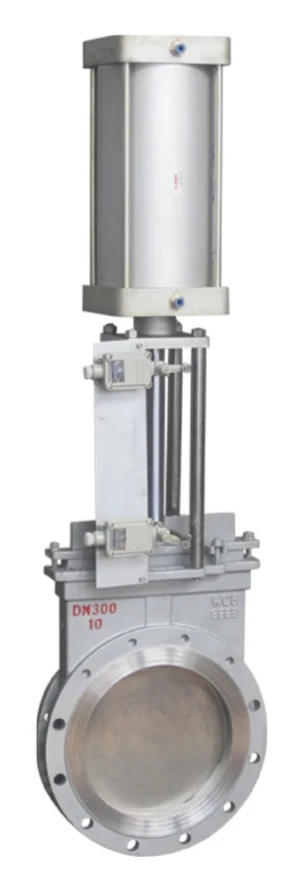
Uma válvula guilhotina pneumática utiliza um cilindro linear para movimentar a guilhotina, permitindo abertura e fechamento por comando remoto. O cilindro fornece o movimento; o corpo da válvula, a guilhotina, a sede e a gaxeta determinam se uma determinada lama ou corrente de processo pode ser isolada. Verifique a compatibilidade de ambos os conjuntos com a aplicação antes de solicitar a cotação.
- Configuração do cilindro pneumático mostrada no catálogo de produtos de origem
- Sentido de assentamento, limites de pressão e comportamento em falha de ar devem ser especificados separadamente
Quando o acionamento pneumático faz sentido?
Escolha o arranjo de acionamento de acordo com os utilitários disponíveis e a sequência operacional, e depois selecione o modelo de válvula guilhotina para o meio e o diferencial de pressão reais. Um acionamento pneumático, por si só, não estabelece compatibilidade com lama, classe de vedação estanque nem função de falha fechada.
Operação remota liga/desliga
Um cilindro pneumático merece avaliação para isolamento repetitivo ou comandado remotamente quando houver ar de instrumento adequado disponível. O tempo de curso, a frequência de ciclos e o empuxo operacional requeridos ainda precisam de um atuador compatível.
O projeto da válvula vem primeiro
Confirme a construção da guilhotina e da sede, o diferencial de pressão do lado do processo e se a pressão a montante ou a jusante pode se inverter. O mesmo tipo de cilindro pode ser montado em válvulas com limites de vazamento e de sentido de fluxo muito diferentes.
O que o catálogo estabelece
A fonte Página de catálogo da série de válvulas guilhotina identifica uma válvula guilhotina pneumática e ilustra um cilindro vertical. Não informa faixa de tamanho, grau de material, classe de pressão, diâmetro do atuador nem desempenho de vedação certificado.
Fatos do catálogo e limites de configuração
O catálogo original identifica o tipo de válvula e a atuação pneumática. A tabela registra apenas esses detalhes confirmados; não interprete a fotografia nem os produtos adjacentes do catálogo como especificação desta válvula.
| Campo | Valor documentado no catálogo | Status da evidência |
|---|---|---|
| Tipo de válvula | Válvula guilhotina | VERIFICADO — rótulo do catálogo em PDF |
| Acionamento | Pneumático | VERIFICADO — rótulo do catálogo em PDF |
| Série de origem no catálogo | Válvula guilhotina | VERIFICADO — seção do catálogo em PDF |
| Página de origem no catálogo | Página 108 do PDF | VERIFICADO — mapeamento de PDF recuperado |
Para cotação: solicite uma ficha técnica e um desenho GA específicos para o tamanho, com dimensões, limites de pressão/temperatura, condições de sentido de fluxo e vazamento, tamanho e curso do cilindro pneumático, além dos requisitos de inspeção acordados.
Especifique o corpo, a comporta e o comportamento de fechamento da válvula
Uma válvula guilhotina deve ser selecionada para o fluxo real e o requisito de fechamento, não apenas por ter uma comporta em forma de lâmina. Solicite a proposta de corpo, comporta, sede e arranjo de gaxeta, com a pressão diferencial e o sentido de fluxo aos quais se aplica a alegação de vazamento.
Comporta, sede e gaxeta
- Corpo e gaveta: selecione materiais em contato com o fluido considerando corrosão, abrasão e exposição; identifique depósitos que possam obstruir o curso.
- Sede e gaxeta: informe a vazão de fuga admissível na vedação de fechamento e os requisitos de vazamento da gaxeta na temperatura e pressão diferencial especificadas.
- Manuseio de sólidos: forneça o percentual de sólidos, tamanho de partícula, dureza, teor de fibras e viscosidade; não presuma que a gaveta corte todos os sólidos ou se autolimpe.
Sentido de pressão e serviço de extremidade
- A vedação unidirecional ou bidirecional deve ser identificada no desenho proposto; um cilindro pneumático não torna a válvula bidirecional.
- Especifique a pressão diferencial máxima de fechamento em cada sentido relevante, não apenas uma designação PN/Class de flange.
- O isolamento em extremidade de linha ou em ponta cega deve ser respaldado por uma classificação declarada de serviço de extremidade e pelo arranjo de instalação exigido.
- Registre os procedimentos de isolamento positivo e manutenção separadamente da operação remota normal da válvula; não equipare um comando de controle a um isolamento seguro para trabalho.
Compatibilize força, curso e controle do cilindro com o serviço
As verificações críticas são se o cilindro consegue mover a gaveta ao longo de todo o curso na menor pressão de ar disponível e o que a válvula faz quando há perda de ar ou de alimentação elétrica de controle. Por exemplo, se a planta exige fechamento na falha de ar, não especifique um cilindro de dupla ação padrão como “falha fechada” sem um mecanismo fail-safe e uma sequência verificados de forma independente.
Empuxo e curso necessários
Specify valve DN/NPS and maximum operating differential pressure, including the closing case. The supplier must size cylinder bore and useful force for process load, seat/packing friction and full gate travel; confirm stroke stops and the fully open/closed positions on the assembly drawing.
Air pressure and speed
Give minimum and maximum instrument-air pressure at the cylinder inlet during movement, air quality, ambient temperature, tubing constraints and required open/close time. A higher nominal plant-header pressure does not guarantee adequate thrust or flow at the actuator.
Loss-of-air response
State the required final position after air loss: open, closed or another controlled condition. A double-acting cylinder normally needs air to drive both directions; spring return or another engineered stored-energy arrangement must be explicitly offered and validated when a fail-action is essential.
Commands and position feedback
Provide control philosophy, solenoid type and coil voltage, control-system interface, local/manual override needs and open/closed limit-switch signals. Do not assume a positioner or modulating control is included; request one only if a suitable throttling-rated valve configuration has been established.
Cycling and documentation
State expected operations per hour/day, duty cycle, target stroke time and maintenance access. Request the valve-and-cylinder GA drawing, pneumatic schematic, accessory list, factory operation/leakage test scope and any witness or material documents required by the project.
Check slurry behavior and the installed end conditions
A valve that opens and closes in clean water may behave differently when particles settle, fibers bridge the bore or abrasive solids reach the seat and packing. The correct decision depends on the medium, the valve construction and the operating cycle.
Solids, fibers and viscosity
Describe liquid/solid composition, concentration by weight or volume, particle-size range, fiber length, viscosity and whether sediment settles during shutdown. Where blockage or accelerated wear is credible, request a specific gate/seat design review rather than assuming every knife gate valve is self-clearing.
Isolation versus throttling
Treat this listing as an isolation-valve inquiry unless the offered construction is explicitly rated for throttling. Frequent partial opening can increase local velocity and erosion at the gate and seat; a control duty requires its own documented range, trim design and actuation package.
Flanges, piping and clearance
Specify end style, mating flange drilling/facing and internal bore, mounting position, permitted flow direction, pipe support and top clearance for the extended cylinder. Confirm face-to-face and bolt engagement on the GA drawing; installation dimensions cannot be measured reliably from the catalog photo.
When to review another knife gate valve
Drive choice and erosion-resistant construction are separate decisions. Use these adjacent catalog records as alternative starting points, not as proof that their dimensions, materials or pressure ranges interchange with this pneumatic valve.
Válvula Guilhotina Cerâmica Elétrica
Explore a motor-operated and ceramic-design listing when instrument air is unavailable or the medium calls for a different wear-resistance strategy. Verify the exact actuator and ceramic construction.
Válvula Guilhotina Cerâmica
Review a ceramic-design listing when abrasion or corrosion may change seat and trim selection; the catalog title alone does not establish the ceramic grade or suitability.
Válvula guilhotina novo tipo
A separate knife gate catalog design. Request its own construction and drawing before assuming it solves sealing, clogging or differential-pressure limitations.
Questions to resolve before ordering
The answers depend on the exact valve and pneumatic assembly offered for the project.
Will the valve close if plant air is lost?
Not automatically. A conventional double-acting cylinder needs air to drive either direction. If loss-of-air closure is required, specify and verify an appropriate fail-close actuator or engineered arrangement and its test sequence.
Can this valve seal against pressure from both directions?
The catalog label does not say. Confirm whether the proposed seat design is unidirectional or bidirectional, the rated shutoff differential pressure in each direction and any end-of-line restrictions.
Is this valve suitable for throttling abrasive slurry?
Do not assume so. The offered gate, seat and actuator must be specifically suitable for partial-open service and the predicted erosion, plugging and control requirements. Otherwise specify it for validated isolation duty.
Which drawing and test details should accompany an offer?
Request a size-specific GA and interface drawing, materials and seat construction, flow-direction and leakage limits, cylinder bore/stroke and air-pressure range, control accessories, operation testing and project inspection requirements.
Request a pneumatic knife gate valve configuration
Send the operating case and required air/control package. Ask for a documented valve-and-actuator configuration, rather than treating the catalog illustration as a complete order specification.
- Service: isolation or control duty, medium composition, solids content/size, fibers, viscosity, abrasion/corrosion and cycle frequency.
- Operating limits: DN/NPS; operating/design pressure, maximum shutoff ΔP in each flow direction, temperature range, surge/vacuum conditions and PN/Class if specified.
- Valve interfaces: body/gate/seat/packing material preferences, sealing direction and allowed leakage, dead-end duty if needed, end connection, flange drilling and installation clearance.
- Air and controls: minimum/maximum pressure at actuator, air quality, stroke time, double/single-acting preference, loss-of-air response, solenoid signal/voltage, limit switches and local override.
- Commercial and QA: quantity, target delivery, GA/pneumatic drawings, test and inspection/witness plan, material documentation and packaging or marking needs.