
Controle de pressão industrial e de sistemas de água
Válvulas redutoras de pressão industriais
Reduzem uma pressão de montante mais alta para uma pressão de jusante controlada em sistemas de distribuição de água e utilidades industriais. Comece pela faixa de pressão de entrada, pela pressão de saída requerida e pela demanda desde a vazão mínima até a de pico; esses dados determinam se a válvula consegue regular dentro da faixa operacional real.
Referência de catálogo: a válvula redutora de pressão em aço inoxidável 200X está ilustrada aqui. Seu tamanho, classe de pressão, ajustes do piloto e adequação a um meio específico exigem documentação no nível da configuração.
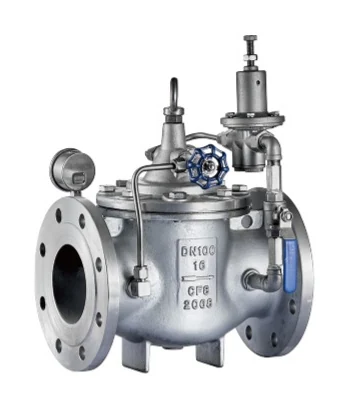
Referência de catálogo: válvula redutora de pressão 200X
O catálogo do fornecedor identifica a válvula ilustrada como uma Válvula Redutora de Pressão 200X em Aço Inoxidável. Confirme a configuração cotada com os documentos atuais do modelo.
Válvula redutora de pressão em aço inoxidável 200X
A ilustração do catálogo mostra uma válvula principal flangeada com tubulação de controle externa e componentes relacionados ao piloto. Solicite o desenho do modelo específico, os limites de pressão e temperatura, a vazão mínima controlável, a faixa de pressão de ajuste do piloto, a conexão de extremidade, os materiais em contato com o meio e a documentação de ensaio aplicável antes de considerá-la compatível com o projeto.
Para uma cotação específica do modelo, envie as faixas de pressão de entrada e saída, os casos de vazão e os requisitos do projeto. A configuração proposta pode então ser analisada em relação aos documentos técnicos atuais.
Escolha o arranjo de controle
Combine o arranjo redutor de pressão com o serviço
Uma válvula redutora de pressão controla a pressão a jusante da válvula quando há pressão de entrada adequada e uma faixa de vazão viável disponível. Defina primeiro o objetivo de pressão; em seguida, avalie a válvula e, quando necessário, a estação ao redor.
Redução de pressão controlada por piloto
Um piloto hidráulico pode detectar a pressão a jusante e modular a válvula principal para manter um setpoint sob oferta e demanda variáveis. Para uma zona municipal ou um header de água industrial, verifique a menor pressão de entrada disponível na demanda de pico e a vazão mínima estável da válvula antes de selecionar seu tamanho. A referência de catálogo 200X não substitui os dados de seu piloto e de capacidade.
Serviço de baixa vazão ou ampla faixa de controle
Se a demanda noturna for muito inferior à vazão de pico diurna, uma única válvula principal de grande porte pode não regular de forma estável na faixa baixa. Compare a vazão mínima controlável do fabricante com a demanda mínima real; onde ela for insuficiente, avalie um ramal paralelo menor devidamente controlado ou outra configuração documentada, em vez de simplesmente aumentar o tamanho nominal da válvula.
Queda de pressão elevada ou continuidade crítica
Uma grande queda de pressão em líquido pode causar cavitação e erosão. Avalie os estágios de pressão e o trim propostos frente às orientações do fabricante sobre cavitação; defina também isolamento, monitoramento, bypass controlado e qualquer proteção independente contra sobrepressão necessária. Essas são decisões de projeto da estação, não recursos incluídos automaticamente na válvula 200X ilustrada.
Condições de dimensionamento
Verifique toda a faixa operacional antes do dimensionamento
A queda de pressão disponível para o regulador não é fixa. Quando a pressão mínima de entrada deixa margem insuficiente acima do setpoint a jusante na vazão de pico, a válvula não consegue criar a pressão faltante. No extremo oposto, uma pressão de entrada alta e um setpoint de saída baixo podem exigir um projeto resistente à cavitação ou com estágios.
| Área de decisão | Informações operacionais necessárias | Consequência na seleção |
|---|---|---|
| Pressão de entrada | Mínima, normal e máxima P1 at the valve (bar or psi) | At minimum P1 and maximum flow, confirm enough differential remains for the selected valve to meet the outlet target. |
| Downstream duty | Required P2 setpoint, acceptable band and maximum allowable pressure | Distinguishes normal regulation from overpressure protection; include no-flow/closed-demand expectations. |
| Flow envelope | Minimum continuous, normal and peak Q (m³/h or gpm); transient cases | Both peak capacity and low-flow controllability must be checked; pipe size alone is not a valve sizing calculation. |
| Liquid pressure drop | High-P1 / low-P2 case, liquid temperature and relevant vapor pressure | Requires manufacturer-specific cavitation assessment; a large pressure ratio is a warning, not a universal cavitation threshold. |
| Water and controls | Water quality, solids, sensing point, pilot filtration and control response | Affects pilot passages, stability, maintenance and instrumentation requirements. |
| Project configuration | Pipe/flange standards, installation orientation, isolation, bypass, records and inspection scope | Ensures the quotation covers the actual valve and station boundaries rather than an assumed complete assembly. |
Application decisions
Where the pressure-reducing duty changes
The same outlet-pressure target can lead to different hardware or station layouts once minimum flow, pressure variation and fluid properties are known.
Municipal distribution pressure zone
Use the highest inlet pressure with low nighttime demand to examine cavitation and low-flow behavior; use the lowest inlet pressure with peak demand to verify headroom and capacity. Include elevation differences, surge conditions and the required outlet-pressure band.
Industrial water header
State whether downstream pressure serves cooling, washing or another utility process, and what happens when the demand changes quickly or the valve is isolated. Determine which gauges, pilot filtration, maintenance access and continuity measures the facility requires; do not assume they are supplied as a standard station. See industry applications for broader service context.
Steam, gas or other process media
Do not apply the pictured water-control catalog valve to another fluid solely because the pressure setpoint appears suitable. Fluid phase, temperature, materials, regulator behavior and applicable documentation need a different product review. For actuated process throttling, see industrial control valves.
Avoid mis-sizing
Four checks that can change the valve choice
An outlet-pressure setpoint is only one part of the specification. The following failures can make an apparently suitable nominal size a poor selection.
- Too little inlet-to-outlet pressure margin at peak flow: confirm the selected valve’s loss and controllability.
- Oversized main valve at minimum demand: check minimum stable flow and low-flow branch options.
- High liquid pressure drop: request configuration-specific cavitation and noise review.
- Assumed failure protection: assess downstream overpressure safeguards independently of normal pressure regulation.
Procurement and engineering review
What a useful pressure-reducing valve proposal should show
A quote should make the chosen control function and its limitations traceable to the submitted operating cases. A model name or generic catalog picture cannot confirm hydraulic performance.
Valve sizing and pressure margin
Request the proposed valve size, rated operating envelope and expected pressure loss at peak flow, along with evidence that the minimum flow is controllable. If minimum inlet pressure cannot support the required outlet pressure, address the system rather than promising a better setpoint controller.
Pilot, trim and station boundary
Identify the main valve, pressure-reducing pilot, sensing arrangement, strainers and specified accessories. Clarify whether isolation, bypass, instrumentation, staged reduction or a standby branch is included, excluded or separately engineered.
Drawings and acceptance basis
Specify the required general arrangement, flange or end dimensions, wetted-material schedule, pressure-temperature data, inspection or test documents and applicable project standards. Do not infer certificates, water-contact approvals or pressure ratings from a catalog illustration. Company-level manufacturing information is not a substitute for this product’s records.
Selection questions
Pressure reducing valve questions before an RFQ
These answers describe the selection logic; a confirmed model datasheet is still required for any specified pressure or flow range.
What if the inlet pressure falls near the outlet setpoint?
A pressure reducing valve dissipates available pressure; it cannot raise outlet pressure above the available supply. If minimum inlet pressure leaves insufficient differential for the required flow, the downstream target may not be maintained. Check the worst-case supply and system losses first.
Why is nighttime or minimum flow important?
At a very low demand, an oversized valve may operate near the end of its controllable range, causing hunting or unstable downstream pressure. Compare the actual minimum demand with the proposed valve’s published control range; a properly regulated small parallel branch may be appropriate.
Is a pressure reducing valve also a pressure relief valve?
No. A reducing valve regulates downstream pressure in normal service; a relief valve addresses overpressure by opening a discharge path. Evaluate independent downstream protection against valve failure, trapped pressure or other overpressure scenarios as required by the system risk assessment.
Rotas de produtos relacionados
Choose the correct valve category
Use the broader hydraulic-control category when the function is not simply downstream pressure reduction, or the process-control category when regulating a process variable with an actuator and control signal.
Hydraulic control valves
Broader pilot-operated water control functions, such as flow, pressure or level duties.
Industrial control valves
Process modulation, actuator selection and control-loop responsibilities.
All industrial valve categories
Compare valve families when the primary duty is isolation, backflow prevention or another function.
Technical resources
Review general engineering topics; request current product submittals for project-specific specifications.
Project inquiry
Send your pressure-reducing duty for review
Provide the available operating cases, not just a nominal valve size and setpoint. For 200X or an alternative proposal, request confirmation of the valve and pilot configuration, minimum-flow stability, cavitation suitability and supplied station components. Unknown values can be marked for follow-up.
- Minimum, normal and maximum upstream pressure (with units)
- Required downstream setpoint, allowable range and no-flow expectation
- Minimum, normal and peak flow (with units)
- Fluid, temperature and water quality or solids
- Pipe size, end connections, installation and station layout
- Control sensing, isolation, bypass and continuity requirements
- Governing project specification and operating limitations
- Requested drawings, tests, material records and certificates