
Robinet à tournant sphérique en acier forgé / produit de catalogue
Robinet à tournant sphérique haute pression en acier forgé en trois pièces
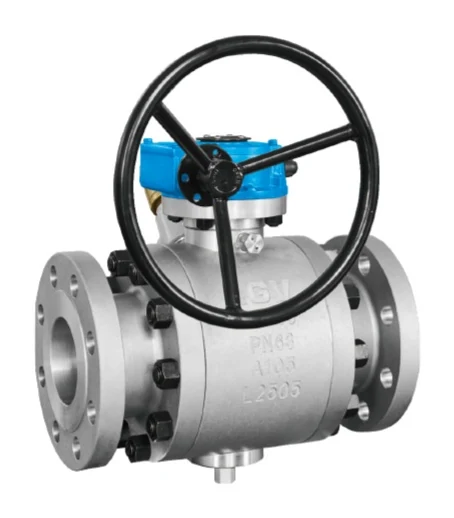
Pour service haute pression tout ou rien, ce catalogue identifie un robinet à tournant sphérique en acier forgé en trois pièces et illustre des exemples à brides, à commande par engrenage. Le choix dépend des limites pression–température proposées, du système de siège, de la conception du joint de corps et des interfaces de tuyauterie—les termes “ haute pression ” n'établissent pas une classe de pression nominale numérique Class ou PN.
- Construction en corps forgé en trois pièces — identification catalogue
- Désignation haute pression — le PN/Class proposé et les limites pression–température nécessitent une confirmation
- Les brides et les opérateurs à volant et engrenage figurent dans les illustrations du catalogue
- Confirmer le siège, la nuance du corps, le support de bille et les limites de service sur la fiche technique proposée
Identité catalogue et données de demande de devis
Ce que le catalogue identifie — et ce que l'offre doit définir
Le catalogue source désigne ce produit comme Robinet à tournant sphérique haute pression en acier forgé en trois pièces dans sa série de robinets à tournant sphérique. Les articles illustrés présentent des extrémités à brides et des volants à commande par engrenage. Les illustrations du catalogue ne fournissent ni tableau de classement propre à la configuration, ni plan coté, ni nomenclature détaillée des matériaux ; les marquages visibles sur le corps ne doivent pas être utilisés comme spécification de devis. Utiliser la source pour l'identification du produit, non pour l'approbation d'une configuration.
| Champ de décision | Éléments du catalogue | Exigé dans l'offre |
|---|---|---|
| Identification du produit | Robinet à tournant sphérique haute pression en acier forgé, trois pièces | Numéro de pièce/modèle et indice de révision du plan proposé |
| Limite de pression | “ Haute pression ” est la désignation du catalogue. Un marquage visible sur une illustration ne constitue pas un classement PN/Class ni un tableau pression–température vérifié permettant la commande. | Pression nominale en fonction de la température pour le corps, le joint de corps et les étanchéités |
| Internes du robinet | Le type de support de bille, l'alésage et la construction du siège ne sont pas indiqués | Floating or trunnion support, full/reduced bore, seat/packing/gasket materials |
| Materials | “Forged steel” appears in the catalog name, without an ASTM/EN grade | Pressure-containing body/ends, ball, stem and wetted-part material grades |
| Illustrated ends and operator | Flanged ends and gear handwheels are visible on the two catalog examples | Flange standard/facing, face-to-face, torque and operator included in the quotation |
| Emplacement source | Ball Valve series; original catalog PDF physical page 89 (printed pages 167–168) | Request the configuration-specific datasheet and general arrangement drawing |
Limite de spécification : Do not treat the photographed flange, gear operator or forged-steel label as a complete bill of materials. Pressure class, seat design, test requirements and delivery configuration belong on the offered datasheet and approved drawing.
Pressure and sealing
Choose the pressure boundary and seat together
A valve can meet a stated body pressure class yet still be unsuitable because the selected seat, packing or body gasket is unsuitable, or because materials are incompatible with the medium. Evaluate design pressure and maximum differential pressure against the full temperature range, including credible transients.
Pressure–temperature limits
- Give design pressure, normal pressure, maximum differential pressure and minimum/maximum temperature; include thermal cycling or vacuum where relevant.
- Ask for the offered pressure–temperature chart and limits for the pressure-containing body, bolted body joints, seats, stem seals and gaskets.
- If trapped liquid could heat in a closed cavity, request the design’s cavity-pressure relief approach; do not assume self-relief.
Media, seats and shutoff
- State fluid composition, phase, solids, concentration, corrosion and erosion exposure, and cleaning media.
- Specify allowable seat leakage and the relevant test acceptance conditions. Seat material suitability depends on pressure, temperature and medium together.
- For frequent throttling or modulating duty, request a control-rated valve assessment; this standard on-off designation alone is not sufficient.
Construction and installation
What the three-piece body changes in practice
A sectional body can offer access to internal parts, but three-piece does not automatically mean swing-out, in-line repair or maintenance under pressure. Access, sealing joints and reassembly depend on the supplied construction and its installation/maintenance instructions.
Body joints and maintenance access
The body-to-end joints, bolting and gaskets form part of the pressure boundary. Before planning service in place, obtain the section drawing, bolting procedure, gasket kit scope and clearance requirements. Any disassembly requires an isolated, depressurized, drained and appropriately decontaminated system under an approved procedure.
Piping connection and fit
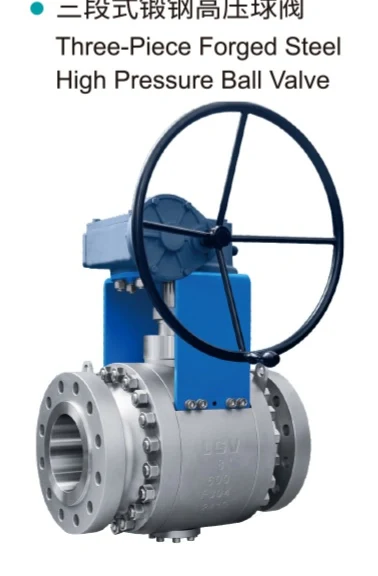
Both catalog illustrations show flanged ends, not an orderable flange specification. Provide DN/NPS, mating flange standard and facing, face-to-face length, bore requirement, gasket/bolt interface, piping loads and installation space. Confirm the actual end configuration on the proposed drawing.
Ball support and bore
The catalog label does not say whether the ball is floating or trunnion-supported. At higher differential pressure, operating torque and seat loading can influence that choice; line size alone does not settle it. State full-bore or reduced-bore requirements, pressure drop and any pigging need before accepting an offered design.
Gear operator, automation and cycling
The pictured handwheel gear units do not prove that every delivered valve includes a gearbox. Supply maximum differential pressure at operation, cycle frequency and required opening/closing time. For remote actuation, request valve torque data, actuator sizing, utility, control signal, fail action and area classification as applicable.
Documents that settle the decision
Request an offered datasheet, general arrangement and sectional drawing, detailed material list, stated design/test standards with editions, leakage acceptance criteria and the inspection/material records required by the purchase order. Do not assume fire-safe, anti-static, fugitive-emission or sour-service qualification without the applicable design and verification evidence.
Original catalog illustrations
Two catalog views of this three-piece high-pressure valve
Both images sit under the same English product label on the original catalog spread. They illustrate flanged ends and gear handwheels; differences in appearance are not proof of interchangeable dimensions, pressure ratings or supplied trim.
Nearby catalog options
When a different three-piece ball valve is the better inquiry
The linked records represent different catalog names—not automatically approved substitutes. Select the inquiry route from the service requirement, then request the datasheet for that exact record.
High Temperature and High Pressure Three-Piece Forged Steel Fixed Ball Valve
If elevated temperature and a supported-ball design are essential, compare this separately labeled high-temperature/high-pressure fixed-ball record. Verify its seat design and temperature-dependent pressure limit before selection.
Robinet à tournant sphérique fixe à joint dur en acier forgé en trois pièces
If the specification calls for hard seating, assess this separately named hard-sealed fixed-ball record. Require leakage criteria, torque, sealing materials and wear limits for the actual duty.
Robinet à tournant sphérique fixe à trois pièces en acier forgé, à commande électrique
If the valve must be operated remotely, review the separate electric fixed-ball record. Verify the ball design and actuator torque, controls, fail action and available power for the proposed assembly.
Technical quotation
Request the three-piece forged-steel ball valve configuration
Reference this catalog product and describe the operating conditions—not just the size and “high pressure.” The inquiry can then be reviewed against a specific proposed valve, with its pressure–temperature limits, sectional drawing, seat system, testing scope and commercial terms.
- Duty, medium and phase, solids/corrosion risks, operating cycles and installation context
- Design and operating pressures, maximum differential pressure, min/max temperature and transient or vacuum cases
- DN/NPS, bore and connection/facing standard, face-to-face requirement and mating piping details
- Body/trim grade, seat and gasket preferences, leakage criteria and pressure-boundary design needs
- Gear/manual or powered actuator, torque/fail-action and utility or control requirements
- Quantity, required standards/editions, drawings, tests, certificates, inspection scope and delivery destination