

MINING & MINERAL PROCESSING
Mining Valves for Slurry, Tailings & Process Water
A thickener underflow line, a dewatering pump discharge, and a clarified-water header do not need the same valve. Start with the solids, the valve function, and what happens when flow stops—then select a construction for technical review.
VALMORA supplies and supports mining valve inquiries, from abrasive slurry isolation to water-service applications. Share the operating conditions so the proposed valve, materials, actuator, and documentation can be evaluated for the actual duty.
APPLICATIONS
Three mining services, three different starting points
Identify the line and the required valve action before comparing catalog categories. A valve that isolates settled slurry is not necessarily suitable for modulating flow or protecting a high-head pump.
Grinding, thickener & tailings slurry
For solids-rich isolation, start with the passage, gate or sleeve sealing arrangement, and the possibility of settled material during shutdown. Review flush access and whether closure occurs under flow or against a stationary solids bed.
Dewatering & process-water pumping
Pump-discharge isolation and reverse-flow protection are separate functions. For a check valve, review pump trip, static head, expected reversal, debris loading, and surge behavior before choosing the closing mechanism.
Reagent & clarified-water circuits
Chemistry may dominate material selection in reagent service; relatively clean water may allow a different valve construction. Where abrasive particles remain, evaluate erosion and compatibility together rather than assuming a liner solves both.
VALVE FAMILIES
Which valve family deserves the first review?
Use the duty—not the industry label—to narrow the shortlist. These routes lead to the dedicated product pages for construction, size, materials, and configuration details.
Bıçaklı Sürgülü Valfler
First review for on/off isolation in solids-bearing slurry lines. Check whether the proposed gate and seat arrangement tolerates particle accumulation, closure load, bidirectional pressure, and any required purge. Do not treat a general-purpose knife gate as slurry-rated by default.
Sıkıştırmalı Valfler
Consider a sleeve-based flow path where the slurry chemistry, pressure differential, temperature, and cycling suit the selected sleeve. Some pinch designs can modulate, but control duty and sleeve wear must be checked for the exact configuration.
Çek Valfler
Review for reverse-flow prevention on dewatering or qualifying slurry systems. Pump trip, system head, solids deposition, and closure dynamics matter; a standard water-service check valve is not automatically a slurry check valve.
Kaplamalı ve Korozyon Önleyici Vanalar
For chemically aggressive water or reagent service, examine wetted materials and lining continuity. If solids are abrasive, evaluate wear exposure and cleaning as well—chemical compatibility alone is not proof of slurry durability.
CATALOG CONSTRUCTION EXAMPLES
See the construction before discussing suitability
The product images on this page are existing supplier-catalog examples, not photographs of VALMORA mine installations. They help identify different constructions and actuation styles; none of the images establishes a pressure rating, wear life, or specific mine-site qualification.
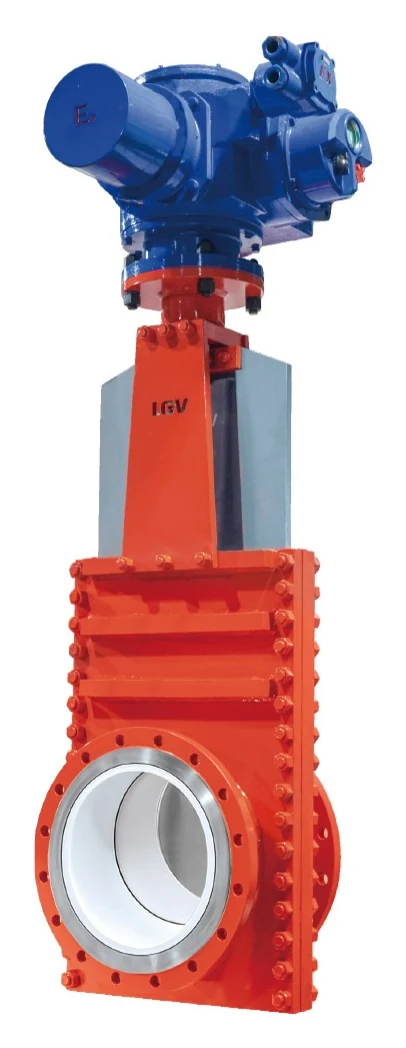
Electric ceramic knife gate
Shown alongside the page introduction. The ceramic construction is a useful starting point for discussing erosive contact surfaces, but particle impact, sealing, and actuator duty still require the actual design data.
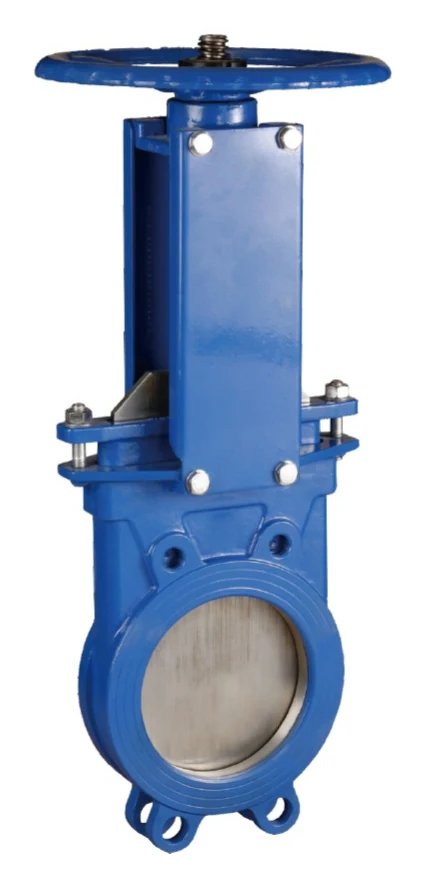
Yeni Tip Knife Gate Vana
The supplier catalog identifies this handwheel-operated example as a “New Type Knife Gate Valve.” The name does not establish its internal design changes, material grade, seat arrangement, or suitability for abrasive slurry. Request the sectional drawing, wetted-material and seat details, and operating limits for the exact offered valve.
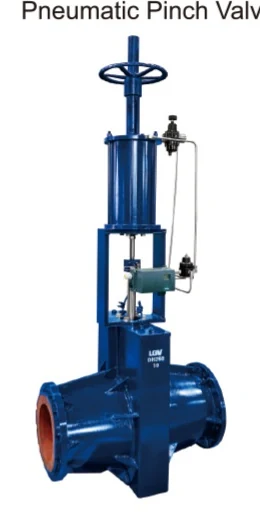
Pneumatic pinch valve
The catalog image below shows a pneumatic pinch valve. Specify the wetted sleeve compound and the actual isolation or throttling duty; actuator type alone does not establish pressure or slurry compatibility.
ENGINEERING INPUTS
Define the duty before requesting a valve configuration
If slurry can settle during an outage, a normally suitable on/off valve may still fail to close against a packed bed. Record the shutdown and restart sequence early; it can change the required seat design, flushing arrangement, and actuator sizing. For process water, first distinguish truly low-solids duty from water carrying abrasive fines.
| What to supply | Specific project data | Effect on selection |
|---|---|---|
| Solids & chemistry | Particle-size range, shape, hardness, solids concentration (state mass or volume basis), settling behavior, pH, reagents, and operating temperature. | Affects obstruction risk, wetted materials, sleeve/seat compatibility, and likely wear mechanisms. |
| Flow & pressure | Normal/minimum/maximum flow, line velocity, normal and maximum differential pressure, static head, and credible surge cases. | Defines pressure boundary and closure loads; do not use the nominal line rating as the only operating pressure. |
| Vana işlevi | On/off isolation or actual modulating duty, cycle frequency, leakage requirement, direction(s) of pressure, and fail-position requirement. | Separates isolation-style knife gates from valves specifically engineered for control; affects actuation and seat duty. |
| Shutdown & cleaning | Pump trip and restart procedure, expected idle periods, settling, flush/purge availability, and safe maintenance access. | Determines whether material can collect across the closure path and how wear parts can be serviced. |
| Interfaces & acceptance | Nominal size, flange/face-to-face requirements, orientation, power or air supply, specification edition, and requested tests/documents. | Allows comparable quoted configurations and identifies interfaces or acceptance criteria to verify. |
SERVICE DECISIONS
When the shortlist needs to change
Use these operating signals to avoid selecting an ordinary water valve for an abrasive line or using an isolation valve as a throttling device. Each alternative is a candidate for review, not an approved product rating.
| Operating signal | First technical route | Critical check |
|---|---|---|
| Solids can settle at shutdown | Examine slurry-service isolation designs and the planned flush/closure sequence. | Can the valve close under the expected bed depth and differential pressure? Review purging and the allowable shutdown procedure. |
| Continuous abrasive throttling | Request a valve engineered and characterized for modulating slurry; a compatible pinch-valve design may be considered. | Confirm control range, differential pressure, sleeve wear, actuation and maintenance interval. Do not throttle with an isolation-only knife gate. |
| High-head pump discharge | Review reverse-flow protection and the pump/system transient response together. | Check trip/restart conditions and check-valve closure dynamics; avoid assuming faster closure always means lower surge. |
| Corrosive liquor with suspended solids | Review lining or corrosion-resistant materials alongside erosion at exposed edges and moving parts. | Verify both chemical compatibility and wear exposure for the quoted wetted construction. |
For each shortlisted configuration, request its applicable pressure/temperature basis, leakage criterion, wetted-material description, and any project-required inspection or qualification documents. Do not substitute another manufacturer’s published limits for the offered valve.
SUBMITTAL & PROCUREMENT
Make the supplier offers comparable
Ask suppliers to identify the offered valve construction, scope of actuator and accessories, and exceptions against the same duty sheet. Agree which drawings, test records, and material information will accompany the order, rather than assuming every catalog item includes the same documentation.
| Review item | Ask for | What to agree |
|---|---|---|
| Duty and tag schedule | System location, valve function, slurry/water properties, minimum/normal/upset cases. | Buyer supplies the basis; unresolved conditions remain explicit. |
| Configuration drawing | Body, gate or sleeve, sealing elements, wetted materials, end connection, actuator and maintenance envelope. | Supplier identifies the exact proposed build and revision. |
| Acceptance & documentation | Applicable project specifications, pressure/shutoff tests, material records and any requested inspection/witness points. | Identify included, conditional and unavailable documents before the PO. |
| Operations & service | Flush and shutdown method, replaceable wear parts, access, and planned maintenance. | Verify that the arrangement fits the operating procedure and access constraints. |
FURTHER DETAIL
Continue with the right technical information
Use Filtreler when screening comparatively low-solids service water or protecting downstream equipment; loading, screen opening, cleaning, and differential pressure must be evaluated before specifying a strainer. For the broader product selection, visit the valve catalog.
All Industries
Other application pages help identify separate duty requirements—not interchangeable valve specifications.
Üretim
Learn about supplier and manufacturing information; verify the specific proposed product separately.
Kalite Kontrol
See quality-process information, then agree the records required for this order.
Technical Resources
Read technical guidance before finalizing the relevant product specification.
PROJECT INQUIRY
Send your mining valve duty for review
Share the equipment tag and valve function, slurry or water composition, pressure and temperature cases, line size and ends, actuation, and any project specification. Attach an existing valve schedule or datasheet if available. Unknown values may be identified as open points instead of being guessed.
- Plant, unit, system and equipment tag
- Valve function and consequence of failure
- Minimum, normal, maximum and upset operating cases
- Medium composition, phase, contaminants and solids
- Line size, ends, orientation, access and actuation
- Project standards, editions and owner specifications
- Testing, inspection, records and witness requirements
- Unknown fields marked for engineering confirmation