
صمامات كروية تحكم هوائية من نوع V
صمامات كروية بمنفذ V للتحكم في التدفق بالتعديل
تُعتبر الصمامات الكروية بمنفذ V عندما تحتاج العملية إلى تحكم قابل للتعديل في التدفق بدلاً من العزل بالفتح أو الإغلاق فقط. يغيّر المنفذ المشكّل مساحة التدفق المتاحة مع دوران الكرة، لكن الاستجابة المركّبة تعتمد على أجزاء الصمام الداخلية والضغط التفاضلي وحلقة التحكم. يحدد كتالوج المصدر لدى VALMORA صمام كروي تحكم هوائي من نوع V منتجات؛ تتطلب سعة التدفق النهائية وتفاصيل الإغلاق والمشغل اختياراً خاصاً بالمنتج.
ابدأ من طبيعة الخدمة: إذا كان الصمام يجب أن يحافظ على مواضع وسيطة عبر نطاق تدفق محدد، فراجع حالات التشغيل أدناه. وإذا كان يحتاج فقط إلى عزل موثوق، فقارن بدلاً من ذلك تصاميم الصمامات الكروية القياسية .
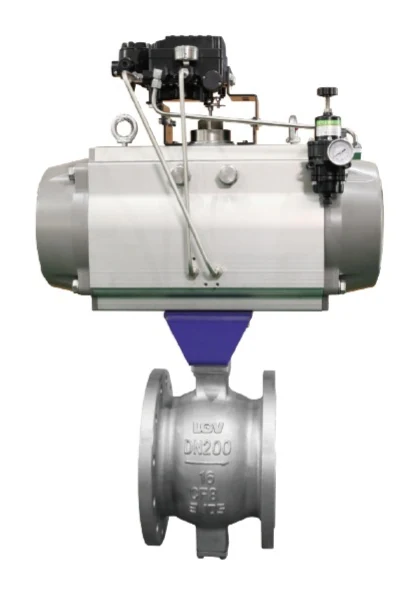
منتج مطابق للكتالوج
صمام كروي تحكم هوائي من نوع V
صفحة الكتالوج المصدر الصفحة الفعلية 93 (الصفحة المطبوعة 176) تحدد صورتين لصمام كروي تحكم من النوع V بالتشغيل الهوائي. كما الصفحة الفعلية 100 (الصفحة المطبوعة 189) تُدرج صمام كروي تحكم من النوع V بالتشغيل الهوائي ضمن صمامات التحكم. تُثبت الصور هوية المنتج فقط—وليس زاوية V معتمدة أو Cv أو مقاسًا أو فئة ضغط.
يظهر التشغيل الهوائي في الكتالوج. اطلب تكوين الصمام/المشغل المعروض وملف المنفذ وبيانات التحديد والمخطط للخدمة الفعلية قبل اعتباره مواصفة قابلة للطلب.
تحديد صمام التحكم
حدد للتدفق التشغيلي الأدنى والعادي والأقصى
Do not select a V-port valve from nominal pipe size alone. First establish the required flow coefficient at each operating case and check whether the proposed valve can regulate the minimum flow without operating near an unstable end of travel, while still passing maximum flow. The inherent port characteristic alone cannot predict installed behavior: the available pressure drop changes with the piping system. Ask for the manufacturer’s Cv or Kv versus valve travel curve, identifying the coefficient convention and the minimum, normal and maximum operating cases used for selection.
| Sizing decision | Buyer data to provide | What the comparison decides |
|---|---|---|
| Flow and usable travel | Minimum, normal, maximum and start-up flow; required controllable range | Whether one proposed trim can handle low-flow control and full-demand capacity |
| Pressure and liquid behavior | Inlet and outlet pressure for each case; vapor pressure when liquid | Differential pressure, choked flow, cavitation or flashing risk and trim suitability |
| Fluid and wear | Liquid, gas or vapor; density, viscosity, temperature, solids/fibers and concentration | Sizing method, seat/trim compatibility, erosion and blockage risk |
| Shutoff and automation | Allowable leakage, fail position, control signal, air supply, feedback and cycle duty | Whether valve seat, actuator and positioner form a suitable operating package |
| Piping and verification | Line size, flange/end details, installation arrangement and required documents | Final dimensional fit, pressure-temperature limits and inspection basis |
Which duties fit?
When V-port control is worth evaluating—and when it is not
The catalog supports a pneumatic V-Type product identity, not a blanket suitability claim for every process. Use the following duty distinctions to decide which specification route to request.
Continuous or frequent throttling
A characterized-port ball valve is a candidate when flow must be adjusted through intermediate positions. Compare the proposed travel-versus-Cv data with minimum and maximum process cases; if control falls into a narrow travel band, ask for different trim sizing or another control-valve design.
Fibers, solids or abrasive liquid
Some V-notch designs can shear or pass fibrous material, but this must not be assumed for the catalog product. Give solids size/concentration, erosion history, cleaning requirements and valve orientation. Conventional IEC 60534-2-1 liquid sizing equations are not intended for slurries or liquid-solid conveyance; request an application-specific review rather than a generic Cv calculation.
Simple isolation or severe pressure reduction
For primarily on/off isolation, first compare standard ball valves and the required seat leakage. For high liquid pressure drop, possible cavitation/flashing, or severe gas noise, do not assume a V-port alone solves the problem: the valve type and trim must be assessed against the actual pressure and fluid cases. See the broader control-valve range if another control architecture may be needed.
Avoid an underspecified quote
Four errors that change the valve you should buy
Nominal size is not a Cv selection. An oversized valve can be difficult to control at low flow even if it passes design maximum. A V-cut does not establish a particular characteristic. Request the actual trim curve and usable travel. Throttling is not zero leakage. State the permitted shutoff leakage separately. An actuator is part of the sizing. Required differential pressure, torque, fail position and positioner performance must be checked together.
- Selecting from nominal size instead of Cv calculation
- Assuming a universal V angle or flow characteristic
- Ignoring shutoff and seat duty
- Using actuator torque without maximum differential pressure
Page and product relationships
Compare the relevant valve routes
Use the V-port series for modulating-flow selection, then open the catalog product for the precise assembly. Broader categories handle other designs rather than competing for this page’s main query.
Ball valves: isolation and other constructions
Ball Valves covers the family, including floating and trunnion-mounted designs. Choose this path if the problem is shutoff, end configuration or ball support rather than continuous modulation.
Control valves: alternative throttling designs
Control Valves is the broader route when pressure control, noise, cavitation, a different trim or a linear control valve may be more suitable.
Exact catalog identity: pneumatic V-Type
Open the Pneumatic V-Type Control Ball Valve catalog entry for its specific identity. The series page does not replace product-level dimensions or a matched quotation.
Valve resources and technical inquiry
Open the VALMORA resources section for additional valve background. For assembly-specific sizing curves, drawings and test records, use the technical RFQ on this page and identify the operating cases and documents required.
Common purchasing questions
V-Port Ball Valve Questions
These are series-level questions. The specific product datasheet and quotation determine orderable values and the accepted documentation.
What project data is needed to specify V-Port Ball Valves?
Give minimum, normal and maximum flow rates (with units), the inlet and outlet pressures at each case, and the fluid phase, temperature, composition and viscosity. Also identify any solids or fibers, line size and end connections, shutoff/leakage duty, required fail action, control signal and available instrument-air supply. The proposed trim, actuator and positioner must then be checked against these operating conditions.
Does the V-Port Ball Valves series name define every available size, pressure class and material?
No. A series name identifies a documented ball valve selection route, but the orderable size, rating, material, connection, standard and operating limits must be confirmed on the offered datasheet and approved order drawing.
How should buyers compare products within the V-Port Ball Valves series?
Compare the manufacturer's Cv or Kv versus travel data against the installed pressure drops and required usable throttling range, including minimum-flow control and maximum-flow capacity. Then compare seat/leakage requirements, port and body construction, end connections, actuator and positioner compatibility, maintenance access, and the offered drawings and test documents.
Which documents should be requested before order approval?
Request the offered datasheet, general arrangement or dimensional drawing, material and trim schedule, applicable inspection and test plan, required certificates, marking details and the final order-specific document list.
استفسار فني
Request a V-port valve and actuator review
Send the process cases you already know. At minimum, provide minimum/normal/maximum flow, inlet and outlet pressures, fluid and operating temperature. Add shutoff criteria, end connections, automation details and the documents you need. If an item is unknown, identify it rather than substituting a nominal-size guess.
- Duty and minimum / normal / maximum flow (with units)
- Inlet and outlet pressures at each flow case; design pressure and temperature
- Fluid composition, phase, viscosity and any solids or fibers
- Line size, end connections, installation arrangement and flow direction
- Shutoff leakage requirement, operating frequency and fail action
- Control signal, available air supply, positioner and feedback requirements
- Requested Cv/travel curve, drawing, material details and testing documents
- Reference the Pneumatic V-Type Control Ball Valve catalog item where relevant