
Isolement industriel • options de produits à bille fixe documentées
Robinets à tournant sphérique sur tourillons
Un robinet à tournant sphérique sur tourillons supporte la bille sur des paliers ou des tourillons, de sorte que la charge de pression est transmise par la structure de support plutôt que de plaquer la bille contre un siège aval. Cette conception mérite un examen lorsque le diamètre d'alésage, la pression différentielle et le couple de manœuvre deviennent plus exigeants. Le choix final dépend toujours de la configuration des sièges, des limites de service et du robinet exact proposé.
Points de départ du catalogue : page 89 répertorie les robinets en acier forgé en trois pièces à étanchéité dure, haute température/haute pression et à commande électrique Robinets à bille fixe. Deux photographies sources de cette page sont formellement identifiées ; l'entrée haute température/haute pression est liée sans photographie associée de manière erronée. Confirmer la configuration de support et la configuration proposée sur un plan spécifique à la commande.
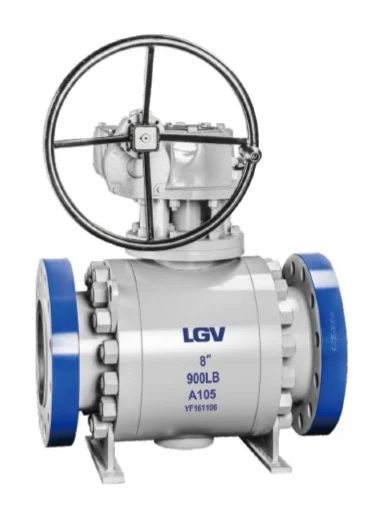
Produits à bille fixe répertoriés au catalogue
Comparer les configurations à bille fixe répertoriées au catalogue
Ces trois entrées sont nommées à la page physique 89 du catalogue fournisseur. Les photos fournies correspondent au produit à étanchéité dure à volant et au produit à commande électrique ; aucune photo correspondante haute température/haute pression n'est fournie dans ce jeu de données. Les noms et images de produits ne prouvent ni les plages pression–température ni une spécification complète.
Le catalogue identifie un robinet à tournant sphérique fixe à trois pièces en acier forgé, à étanchéité métallique. “ Étanchéité métallique ” ne précise pas les matériaux d'étanchéité exacts, la classe d'étanchéité, la configuration des sièges ni la température admissible. Demandez un plan de coupe et un programme de sièges/garnitures spécifié.
Le catalogue désigne séparément un robinet à tournant sphérique fixe à trois pièces en acier forgé pour haute température/haute pression. Il s'agit de termes descriptifs, et non de limites de température ou de pression vérifiées. Vérifiez les matériaux proposés pour le corps, les garnitures et les sièges au regard des ratings pression–température et des cas de service.
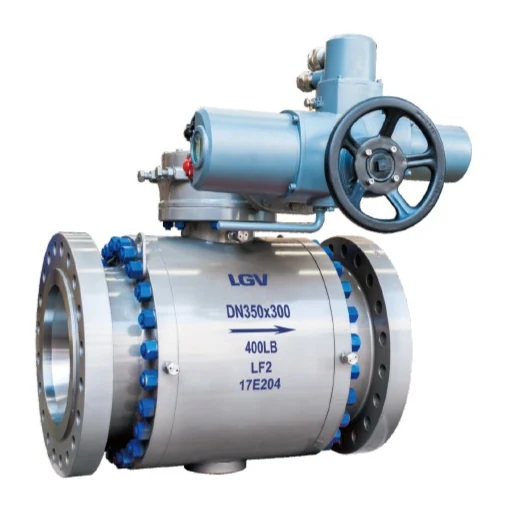
La photographie fournie montre la référence catalogue du robinet à bille fixe à commande électrique, distincte du produit haute température/haute pression. Le type d'entraînement, les limites de couple, l'alimentation, les commandes et le comportement en cas de défaillance nécessitent un ensemble d'actionneur spécifique à la commande.
Référence produit d'origine
Principe de fonctionnement et disposition des sièges
Why ball support and seat design must be specified together
In a floating-ball valve, line pressure shifts the ball into the downstream seat. In a trunnion-supported design, the ball is restrained and the seat assemblies provide sealing contact. That changes the load path, but it does not define the seat sealing direction or the body-cavity relief route. The offered cross-section must establish both.
Support and torque
Supporting the ball independently of the seats can make large-bore or high-differential-pressure isolation more practical. Do not assume a particular torque saving: compare maximum operating differential pressure and the supplier’s breakaway, running and seating torque data before choosing a gearbox or actuator.
Self-relieving seats (SPE)
With a single-piston-effect seat design, a seat may lift to relieve excessive trapped body-cavity pressure into a pipeline side. Which side receives relief and under what pressure conditions depend on the actual seat geometry and valve configuration. It is not guaranteed by the term “trunnion mounted.”
Non-self-relieving seats (DPE)
A double-piston-effect seat may seal against pressure from the line or the body cavity. Two non-self-relieving seats can retain pressure from thermal expansion of trapped liquid; the system must provide an engineered cavity-pressure protection route. Request the actual SPE/DPE combination and isolation/bleed performance before specifying DBB or DIB service.
Décisions de configuration
Specify the duty before choosing the valve configuration
Use the table to determine what must be decided at series level and what must be verified for the exact offered product. A pressure class or “high-pressure” label alone cannot establish suitability at the operating temperature.
| Décision | Données du client | What the supplier must establish |
|---|---|---|
| Load and shutoff | Maximum and minimum operating pressure; design pressure; all temperature cases; medium; isolation leakage requirement | Compare pressure–temperature data and the appropriate seat/trim arrangement. Do not assume Class rating is a fixed allowable working pressure. |
| Seat and cavity | Required isolation direction; SPE/DPE arrangement; trapped-liquid risk; vent or relief destination; DBB/DIB intent | Specify a demonstrated seat configuration and safe cavity-pressure management, rather than assuming these functions from ball support. |
| Bore and connections | Nominal pipe size; full/reduced bore; required minimum flow passage; pigging; flanged/welded ends and mating standard | Confirm dimensions and unobstructed passage from an approved GA/section drawing. A product photograph cannot prove piggability. |
| Fonctionnement | Maximum operating differential pressure; operating frequency; required opening time; manual or powered operation; fail position | Obtain supplier torque curves/values for the selected service and size the gearbox or actuator with the applicable margin and controls. |
| Verification | Valve construction; pressure test and shutoff criteria; project standards; material records; inspection and documentation | Agree the applicable standard edition and order-specific evidence. A catalog entry does not establish API approval or product certifications. |
Where the supported-ball design is worth evaluating
Three duties that change the specification
The following are common engineering selection scenarios, not documented installations or approved operating claims for the catalog entries shown here.
Pipeline isolation and possible pigging
Consider a supported-ball design when valve bore and pressure differential make downstream-seat loading a concern. If pigs must pass, specify the minimum clear bore and require an approved through-bore drawing; “full port” and piggable service are not proved by an exterior photo.
Hot or thermally cycled isolation
Check the complete pressure–temperature envelope, including shutdown and trapped-liquid conditions. High-temperature service may change the allowable seat, stem seal and body-joint materials; the high-temperature/high-pressure catalog entry’s name alone establishes no numeric limit. Verify the cavity-pressure relief route.
Gear-operated or automated valves
For remote or frequent operation, obtain operating and maximum differential pressure, start/run/end torque, cycling duty, actuator power, fail action and controls interface. Confirm gearbox or actuator mounting and the final installed arrangement; a photographed handwheel is not proof of automatic actuation availability.
Evidence and purchasing documents
What the catalog confirms—and what a quotation must add
The original catalog is useful for identifying real product options. Before order approval, use the exact product drawing and quotation to establish the performance and document package.
Identité documentée
Physical catalog page 89 lists separate three-piece forged-steel fixed-ball entries: hard-sealed, high-temperature/high-pressure and electric. The supplied photographs show the gray hard-sealed handwheel valve and the electrically operated valve; the high-temperature/high-pressure product retains a text-only catalog link here. No numeric pressure or temperature rating is established.
Confirm the offered build
Ask for the ball support section, body-entry construction, seat/trim and seals, size, rated pressure–temperature envelope, bore, ends, cavity-relief path, torque and actuator/gearbox arrangement. If a requirement cannot be supported by the offered catalog entry, seek a different verified configuration.
Agree documentation
Identify the requested GA/dimensional drawing, datasheet, inspection and pressure-test basis, material traceability, and any project-required certification. Confirm which documents will be supplied for the actual order; catalog presentation and a general quality page do not constitute test results.
Select the appropriate buying route
Trunnion, floating, fully welded and DBB are different decisions
If the load path is still undecided, compare floating ball valves. If minimizing body joints is the priority, review fully welded ball valves; a welded body does not, by itself, prove a particular ball support or seat design. For a specified isolation-and-bleed function, see DBB ball valves and define the required sealing and bleed test. This page remains the trunnion-series selection and RFQ route; the linked product records retain their exact identities.
Browse the Ball Valves category
Use the parent category to choose a different ball-valve construction or operating function.
Explore other industrial valves
Compare ball valves with other isolation and control valve families.
Review service requirements
Connect material, pressure, thermal cycling and operating conditions to the relevant industry context.
Read technical comparisons
Use the technical library for additional design explanations; the supplier proposal must still identify the exact configuration.
Before issuing a purchase specification
Questions that resolve a trunnion-ball-valve RFQ
These answers concern series-level selection. The catalog entries shown here do not establish verified size, pressure, temperature or certification ranges.
What project data is needed to specify Trunnion Mounted Ball Valves?
Précisez le service d'isolement ou de régulation, l'exigence d'alésage, le sens d'écoulement, les cas de pression et de température, la fréquence de manœuvre, l'exigence de siège/étanchéité, l'exigence de décharge de cavité et le mode d'actionnement.
Does the Trunnion Mounted Ball Valves series name define every available size, pressure class and material?
Non. Un nom de série identifie une voie de sélection documentée de robinet à tournant sphérique, mais la taille commandable, la classe de pression, le matériau, le raccordement, la norme et les limites de service doivent être confirmés sur la fiche technique proposée et sur le plan de commande approuvé.
How should buyers compare products within the Trunnion Mounted Ball Valves series?
Compare body construction, entry and maintenance access, bore/port geometry, seat concept, end connection, actuation, cavity-pressure management and required project documents.
Which documents should be requested before order approval?
Request the offered datasheet, general arrangement or dimensional drawing, material and trim schedule, applicable inspection and test plan, required certificates, marking details and the final order-specific document list.
Request a configuration and supporting documents
Request a trunnion mounted ball valve quotation
Name the catalog product or describe the required trunnion-supported construction. Include the conditions you know, especially differential pressure, seat isolation direction and body-cavity relief. Ask the supplier to identify any unsupported requirements and return a product-specific datasheet and drawing with the quotation.
- Exact product or series identity under review
- Design and operating pressure and temperature cases
- Medium, composition, phase and solids where relevant
- Nominal size, end connection and installation orientation
- Valve duty, operating frequency and actuation requirements
- Applicable project specification and required standards
- Drawings, testing, inspection and documentation requirements
- Unknown fields clearly marked for technical confirmation